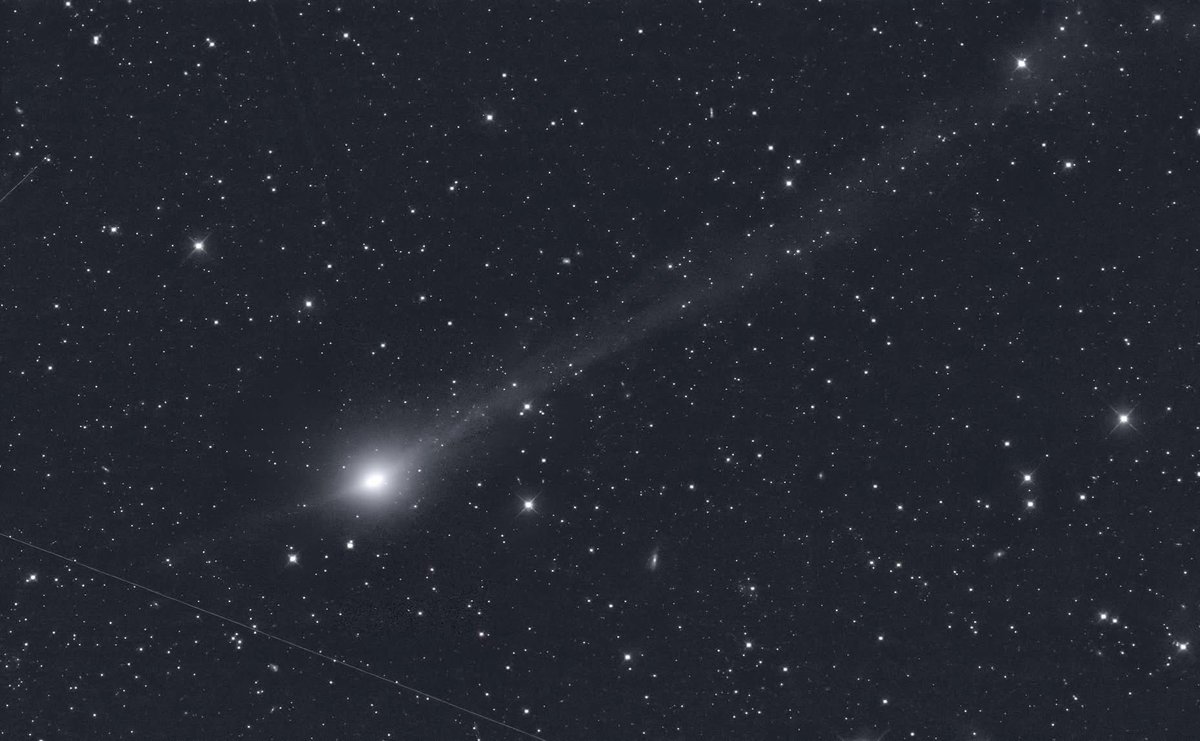
The interstellar comet 3I/ATLAS has emerged as a subject of intense scrutiny as astronomers report an unexpected energy boost, leading to speculations about extraterrestrial origins. Detected on July 1, 2025, using the ATLAS telescope, this object is the third known interstellar entity to traverse our solar system. Its surprising behavior has drawn the attention of scientists, including renowned physicist Michio Kaku, who previously dismissed theories of alien spacecraft as baseless.
As 3I/ATLAS approached the Sun on October 29, 2025, it exhibited unusual characteristics, sprouting at least seven jets and revealing a composition distinct from typical comets. Initial findings suggested a significant age of approximately seven billion years, with elevated levels of nickel and iron. These features have led to ongoing debates about the object’s origins and implications for our understanding of interstellar visitors.
Scientific Observations Raise Questions
NASA’s multi-lens observations provided crucial data about 3I/ATLAS, revealing its complex chemistry, which appears to align with materials from an older star system. The comet’s hyperbolic trajectory has effectively ruled out local solar origins, further complicating its classification. On September 8 and 9, 2025, NASA’s Psyche mission captured detailed images of the comet when it was approximately 33 million miles (53 million kilometers) away, showcasing intricate details of its coma structure.
Simultaneously, the European Space Agency’s ExoMars Trace Gas Orbiter refined the comet’s trajectory with remarkable precision, enhancing our understanding of its path through the solar system. Despite initial skepticism regarding exotic claims, the comet’s lack of a typical tail and other anomalies have prompted scientists to reconsider established models of comet behavior.
Kaku, who had initially countered the theories of Avi Loeb—an advocate for the idea that 3I/ATLAS may be an artificial object—has recently acknowledged the potential significance of new data. On October 30, 2025, he warned observers to monitor the comet closely for any signs of an energy increase. His caution was based on the premise that an acceleration could indicate the presence of a visiting extraterrestrial probe.
Debates on Extraterrestrial Origins Intensify
Recent measurements taken on November 24, 2025, showed an acceleration of 4 × 10⁻⁷ au/day², closely aligning with Kaku’s threshold for extraterrestrial signals. This development has rekindled discussions about the nature of 3I/ATLAS, with Kaku balancing skepticism and openness as evidence continues to accumulate. He has urged caution in interpreting these findings, emphasizing the need for rigorous analysis to avoid fueling public panic.
Loeb’s assertions regarding the comet’s potential artificial origins have gained traction as he points to several anomalies, including its extreme polarization and trajectory shifts. He suggests that 3I/ATLAS could be functioning as a probe, possibly sending signals towards Jupiter, which has elevated its status on Loeb’s proposed scale of extraterrestrial technology.
Critics of Loeb’s hypothesis, particularly within the comet research community, argue that the observed features of 3I/ATLAS can be explained by natural processes, describing the object as an unfamiliar type of interstellar iceberg. Nevertheless, the recent energy boost has reignited debates about the comet’s origins and implications for the search for extraterrestrial intelligence.
As 3I/ATLAS approaches its closest point to Earth on December 19, 2025, astronomers anticipate that further observations may yield revelations that could significantly impact future initiatives, including the Search for Extraterrestrial Intelligence (SETI). The unfolding story of 3I/ATLAS underscores the dynamic nature of modern astronomy, where new data continually challenges and refines our understanding of the cosmos.
This anomaly in the sky serves not only as an object of scientific inquiry but also as a catalyst for collaboration among researchers. As the investigation into 3I/ATLAS continues, it highlights the importance of interdisciplinary approaches in the quest to understand the complexities of interstellar phenomena and the potential for life beyond our planet.