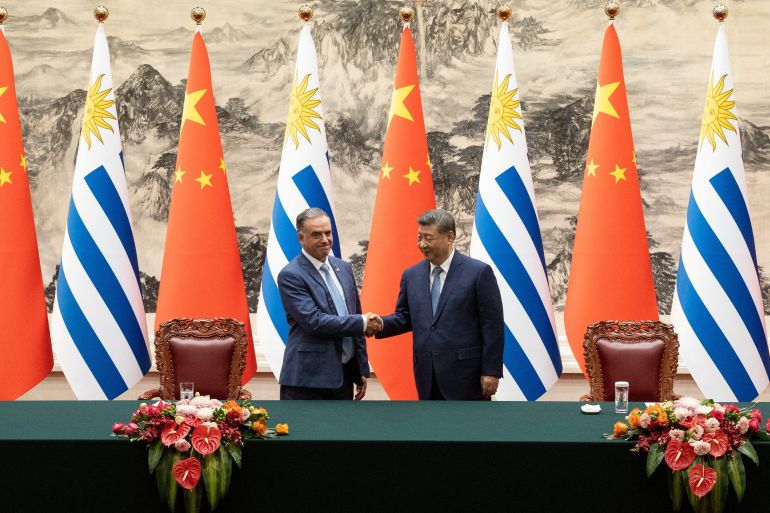
Uruguay’s President Yamandu Orsi has taken significant steps to enhance his country’s relationship with China, signing a series of cooperation agreements despite pressure from United States President Donald Trump to limit Chinese influence in Latin America. During a recent meeting in Beijing with Chinese President Xi Jinping, the two leaders formalized a dozen agreements covering various sectors, including science, technology, and trade.
In a statement shared on social media, Orsi emphasized that Uruguay is actively engaging on the international stage, aiming to strengthen long-term relationships and create new opportunities for national development. A Chinese communiqué from the meeting highlighted Xi’s call for a “multipolar world and inclusive economic globalization,” as both leaders underscored their commitment to a “comprehensive strategic partnership.”
Orsi’s Delegation and Significance of the Visit
Orsi’s visit to China, which commenced on January 7, 2024, is notable as he becomes the first Latin American leader to visit since the controversial abduction of Venezuelan President Nicolás Maduro by US special forces in early January. The trip includes a 150-member delegation comprising business leaders and government officials, reflecting the importance of this diplomatic engagement.
The timing of Orsi’s visit is critical, especially given the United States’ efforts to maintain its influence in the Western Hemisphere. Trump’s administration has articulated its desire to keep the region “free of hostile foreign incursion,” a reference perceived to target growing Chinese involvement.
According to William Yang, a senior analyst for Northeast Asia at the International Crisis Group, Orsi’s actions signal a determination to pursue closer ties with China despite US warnings. Yang noted, “By bringing a delegation of 150 people, including business leaders, the trip sends a message that China remains the top economic and trading partner for countries in Latin America.”
Trade Relations and Economic Implications
China is a crucial market for Uruguayan exports, including beef, soybeans, and dairy products, which totaled approximately $3.49 billion last year. Conversely, Uruguay imported goods worth $2.8 billion from China in the same period. This robust trade relationship illustrates the economic rationale behind Orsi’s diplomatic initiatives.
Orsi’s outreach to China is not an isolated case. His visit follows recent engagements by leaders from other countries, including United Kingdom Prime Minister Keir Starmer, Canadian Prime Minister Mark Carney, Finnish Prime Minister Petteri Orpo, and French President Emmanuel Macron. Yang pointed out that these developments do not necessarily indicate a fundamental shift away from the United States, but rather a recalibration of relationships with the world’s two leading economies.
The Chinese government has utilized these high-level meetings to position itself as a reliable diplomatic partner, emphasizing a commitment to developing relationships, particularly in contrast to the previous US administration’s approach.
As Uruguay seeks to balance its international relations, Orsi’s visit to China underlines the complexities of global diplomacy and the ongoing power dynamics between major world players. The repercussions of this engagement will likely resonate across the region as other countries observe Uruguay’s stance towards both China and the United States.