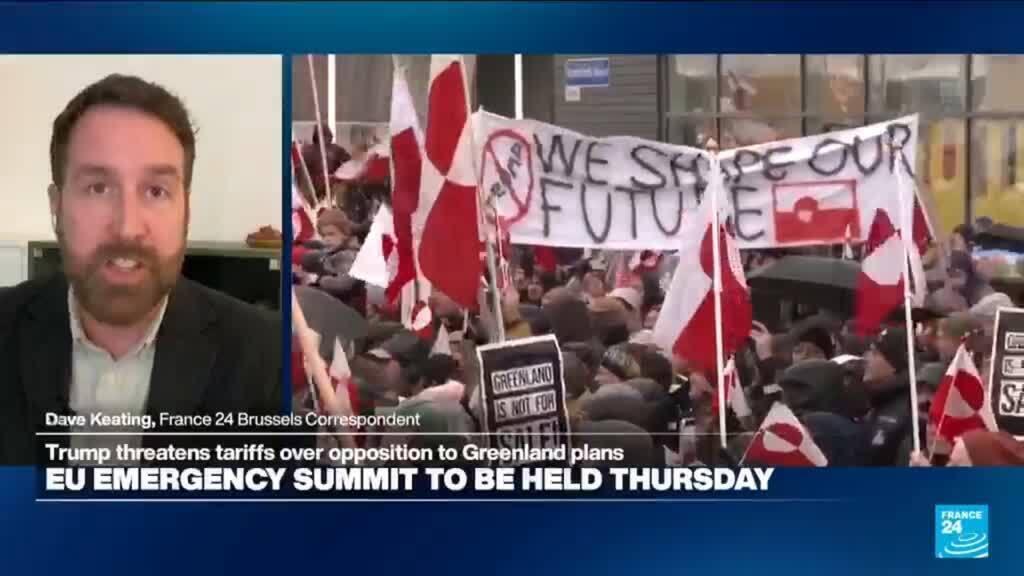
Tensions escalated on March 25, 2024, as President Donald Trump reignited his controversial interest in acquiring Greenland, prompting urgent crisis meetings across Europe. The European Union responded to Trump’s remarks by expressing a desire to engage diplomatically while also preparing to implement countermeasures if necessary.
In a statement made on Monday, the EU emphasized its commitment to dialogue but warned that it would act decisively in the face of potential tariffs threatened by the U.S. The situation reflects not only the complexities of transatlantic relations but also the divisions that appear to be emerging among EU member states.
According to Dave Keating, a correspondent for FRANCE 24 in Brussels, “there are signs of a split between European leaders as the reality of the situation sets in.” This fragmentation within the EU indicates differing approaches to handling Trump’s aggressive trade stance and his fixation on Greenland, which he previously described as a “strategic asset.”
As discussions unfold, EU leaders are grappling with how to respond effectively to Trump’s threats, which could significantly impact trade relations. The potential for tariffs adds a layer of urgency, as European countries seek to protect their economic interests while navigating the unpredictability of U.S. foreign policy.
The backdrop of this situation is heightened by Trump’s previous statements expressing interest in purchasing Greenland from Denmark, a notion met with ridicule and outright rejection from Danish officials. Nevertheless, Trump’s insistence on the matter continues to provoke strong reactions across Europe, forcing leaders to reconsider their diplomatic strategies.
In light of these developments, EU officials are exploring a coordinated response that balances the need for strong diplomacy with the readiness to counteract any harmful trade measures. The implications of this situation could extend beyond Greenland, affecting various sectors and economic ties between the U.S. and Europe.
As the crisis meetings progress, the focus remains on finding a viable resolution that safeguards European interests while also addressing the unpredictability of Trump’s administration. The unfolding dynamics will likely influence not only trade policies but also the broader geopolitical landscape in the coming weeks.
The situation remains fluid, and how the EU ultimately responds could set important precedents for future interactions with the United States. As leaders convene to discuss strategies, the world watches closely, aware that the outcome could resonate far beyond the immediate issue of Greenland.