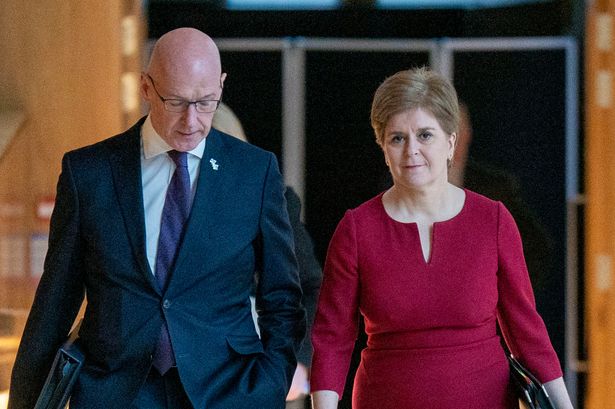
John Swinney is preparing to lead one of the most significant independence-focused election campaigns in the history of the Scottish National Party (SNP). Emphasizing his party’s foundational mission, Swinney has declared that securing an overall majority in the upcoming elections is crucial for advancing plans for a second independence referendum, referred to as indyref2. He has stated that victory would allow him to push the UK Government for a referendum if the SNP achieves at least 65 seats in the Scottish Parliament.
The stakes are high for Swinney, as the SNP’s ability to secure a majority after nearly two decades in power is uncertain. While Scottish Green co-leader Ross Greer suggested the chances are “less than 1%,” others view this as an exaggeration. Even former First Minister Nicola Sturgeon characterized Swinney’s ambitions as “ambitious,” hinting at the challenges ahead.
Despite this, the SNP received a boost when the pro-independence Green Party announced they would only contest a limited number of constituencies in the May 2024 Holyrood elections. This strategy is designed to improve the SNP’s chances in the first-past-the-post system, yet achieving the necessary 65 seats remains a formidable task for a government facing scrutiny.
Swinney’s strategy is not without personal implications. If he succeeds in securing a majority, it could signify a major shift in Scottish politics, placing significant pressure on the UK Government, which is already grappling with issues of its own. A Labour Government, currently facing scandals, might be viewed unfavorably if it outright rejects calls for indyref2.
Conversely, if the SNP falls short, Swinney may still find a silver lining. His tenure could end with him stepping down gracefully, citing the high bar he set for a referendum. If he does not secure the necessary seats, he could exit the political stage, having made room for new leadership within the party.
The reality is that the SNP’s focus on indyref2 poses risks for the party’s future. Current opinion polls suggest that while a pro-independence majority with the Greens is possible, it does not guarantee an outright victory for the SNP. Such an outcome could lead to stagnation within the independence movement, as Swinney’s commitment to indyref2 would restrict the options available to a new leader should they emerge, such as Stephen Flynn or Mairi McAllan.
Insider sources indicated that neither Flynn nor McAllan could alter the party’s stance on indyref2 without another election, further complicating the SNP’s trajectory. The party has thrived for over a decade on the perception that independence is just around the corner, with leaders including Sturgeon and Swinney maintaining the momentum through various promises and milestones.
The potential for internal conflict looms large if independence is sidelined for an extended period. Swinney’s current strategy may lead to a partial victory, but it raises critical questions about the long-term viability of the SNP as a political force. As the elections approach, the party’s future hinges on Swinney’s ability to navigate these turbulent waters.