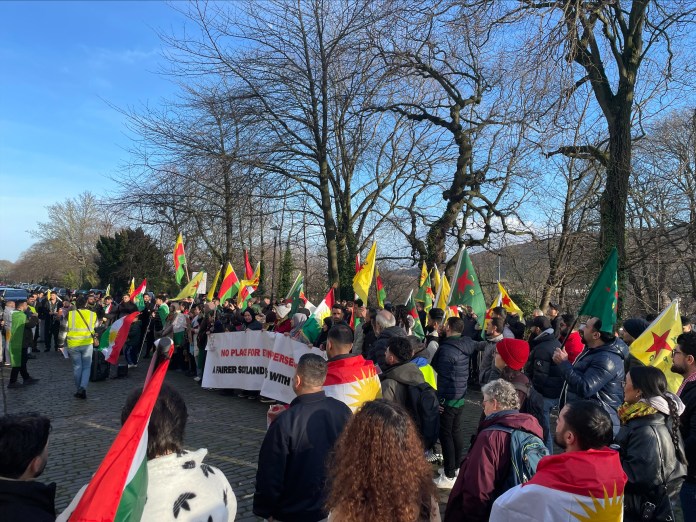
Hundreds of Kurdish activists gathered outside the US Consulate in Edinburgh on March 15, 2025, to demand international action following a significant military assault by Syrian forces on Kurdish-controlled regions. Participants expressed concerns over threats of genocide and lamented what they termed the media’s silence on the ongoing crisis. The protest was marked by heightened security in light of recent violent incidents targeting Kurds, including a mass stabbing in Antwerp, Belgium.
Protesters displayed Kurdish flags as they called for pressure on the Syrian government from both the United States and the United Kingdom. The gathering reflected a broader movement, with Kurdish communities across Europe organizing similar demonstrations in response to the assault led by Ahmed al-Sharaa, the former al-Qaeda leader who took control in Syria at the end of 2024.
Community Response and Security Measures
The event attracted a diverse crowd, including local residents, children, and members of the Kurdish community. The presence of masked security personnel known as the “Kurdish Black Tigers” added a layer of protection for the demonstrators. These forces have been active in Europe, ensuring the safety of Kurdish protests amidst a backdrop of rising anti-Kurdish violence.
Ugur, an organizer of the protest, emphasized the role of the Scottish government in advocating for Kurdish rights. “Edinburgh, as the capital of Scotland, is the best place to draw attention to what’s happening in Kurdistan,” he stated. He criticized the perceived abandonment of the Kurds by Western powers, asserting that the Kurdish forces have played a crucial role in combating terrorism.
The protest’s atmosphere echoed sentiments of betrayal, with many participants voicing fears that Kurdish achievements in autonomy and governance could be at risk. Kurdish forces, part of the multi-ethnic Syrian Democratic Forces (SDF), have governed substantial territories in northeastern Syria since 2015, promoting a democratic and inclusive society known as Rojava.
Accusations of Genocide and Calls for Action
During the rally, demonstrators raised banners and chanted slogans such as “free Kurdistan” and “Julani terrorist,” reflecting their anger towards the Syrian regime. One participant, Belal, described the assault as “genocide,” asserting that the Syrian government is perpetrating violence against the Kurdish population. He criticized European and American media for neglecting the plight of the Kurds, stating, “Nobody talks about Kurdistan.”
Concerns were voiced about the potential release of thousands of ISIS fighters held in Kurdish-controlled prisons amid the chaos. The atmosphere was tense, with the Kurdish Black Tigers asserting their commitment to maintaining order and protecting protestors. Commander Charlie explained their presence, stating, “We are part of the community, we protect the women, children, and elderly who come to the protests.”
The protest highlighted a growing unease among Kurds regarding their security and future as hostilities escalate. Jiyan Avesta, representing the Kurdish LGBTQ community, articulated feelings of neglect, lamenting the loss of support from Western allies. “We feel we have been used for their own interests,” she said, adding that Kurdish forces are now left to defend themselves against overwhelming odds.
As the situation continues to evolve, the Kurdish community remains vigilant, calling for solidarity and action from the international community to protect their rights and lives. The ongoing conflict in Syria has seen Kurdish territories dwindle, with estimates suggesting that Kurdistan has lost around 80% of its territory since the onset of the recent Syrian assaults.
Negotiations between the Syrian government and Rojava leaders have faltered, leading to fears of a forced integration of Kurdish regions into the Syrian state. As the rally concluded, participants left with a renewed commitment to advocate for their rights, hoping that their voices would not go unheard in the corridors of power.