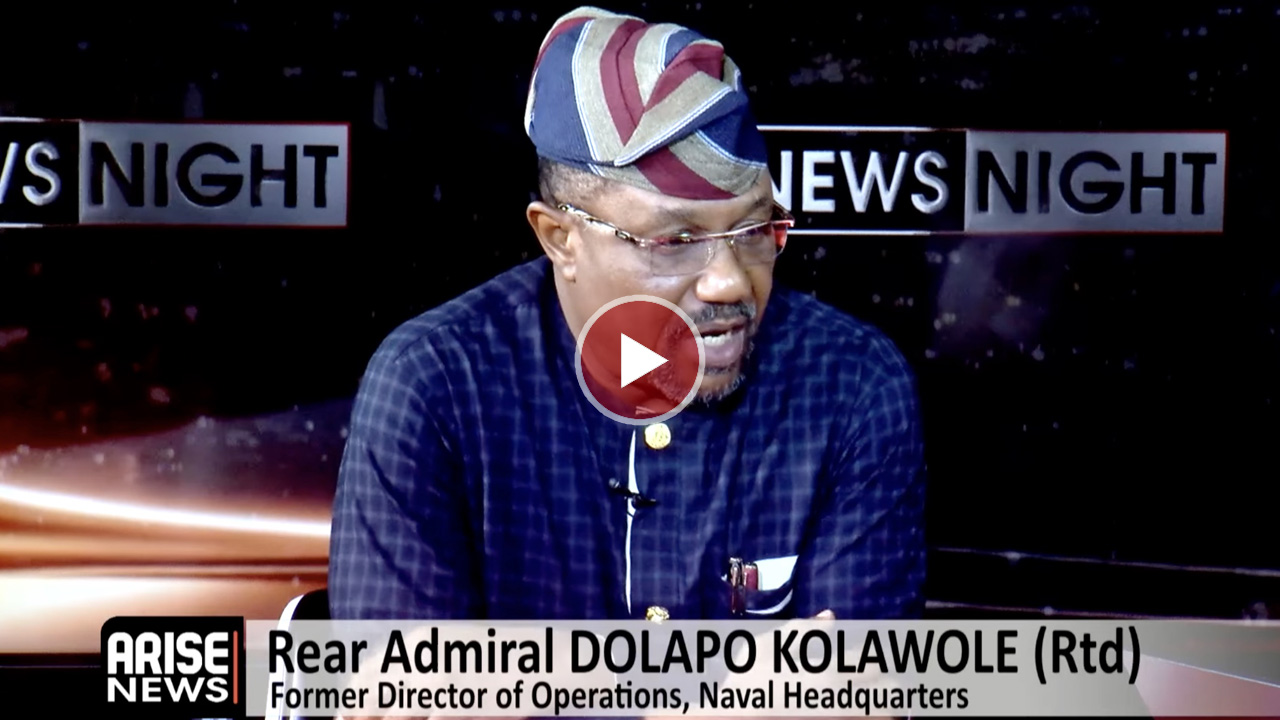
Rear Admiral Dolapo Kolawole (retd), the former Director of Operations at the Naval Headquarters, has identified intelligence failures as the primary driver behind Nigeria’s ongoing insecurity, rather than a deficiency in military capacity. During an interview with ARISE News, Kolawole emphasized that enhancing human intelligence and infiltrating terrorist networks is crucial for curbing violence in the country, especially amid recent mass killings.
The discussion arose in light of the confirmed deployment of a small team of United States troops to Nigeria, coinciding with a resurgence of deadly attacks, including assaults on security personnel and civilians in Benue State and mass casualties reported in Kwara State. Kolawole commended the Nigerian armed forces, particularly the Navy, for being ranked as the strongest in Africa.
“First of all, let me congratulate the federal government, the Nigerian people, and the armed forces of Nigeria on the current global power rating of the Nigerian Navy as the most powerful in Africa,” Kolawole stated. He attributed this distinction to the scale of the Navy’s assets, noting that it currently operates 152 platforms, surpassing every other navy on the continent.
Kolawole asserted that the size and composition of the naval fleet are well-aligned with Nigeria’s security needs and regional responsibilities. “Our current fleet is very much suited for Nigeria’s threat perception and our global ambitions,” he remarked. He pointed out that the Nigerian Navy possesses specialized capabilities that can be deployed in asymmetric warfare, particularly through the Navy Special Boat Service, which he once commanded.
This elite unit is modeled after the United States Navy SEALs and is trained for complex counterterrorism operations on both land and sea. Kolawole indicated that the Special Boat Service could be deployed for surgical strikes against terrorist camps, aimed at preventing further violence.
Despite the Navy’s capabilities, Kolawole stressed that military hardware alone cannot address the root causes of insecurity. He highlighted intelligence as the most vital component of national security. “When I don’t have the prerequisite intelligence to know who, where, and what their intentions are, then they are able to seize the initiative,” he explained.
Kolawole noted that terrorists exploit the weaknesses in Nigeria’s intelligence framework, allowing them to operate with impunity. He urged for a significant enhancement in the country’s intelligence-gathering capabilities, particularly through human intelligence and infiltration of terrorist organizations. “With groups like this, a basic way out is human intelligence,” he said, advocating for deeper infiltration by intelligence services, including the Defence Intelligence Agency and the Department of State Services.
On the topic of maritime security, Kolawole dismissed claims that piracy and oil theft undermine the Navy’s high ranking. He acknowledged that while these issues remain, their prevalence has significantly decreased. “Even with the most effective militaries, it is difficult to have a completely crime-free environment,” he noted, attributing improvements in maritime security to enhanced naval capacity.
Kolawole described Nigeria’s approach to maritime security as a collaborative effort involving the government, the Navy, and local communities. This partnership aims to reduce tensions between security forces and host communities, especially those impacted by militant activities. He encouraged private maritime security companies to view the Navy as a partner rather than a competitor, stating that collaboration could alleviate existing tensions.
Regarding the presence of US troops in Nigeria, Kolawole viewed it as an opportunity for deeper military cooperation but stressed the need for clarity from Nigerian authorities. “Basic strategic military logic dictates that if we are going to have collaborative efforts with the United States, there will be a joint operations centre,” he explained.
He called for transparency about the deployment, urging the Minister of Defence and the US Africa Command (AFRICOM) to provide detailed information about the mission and composition of the US troops. “Nigerians deserve to know the purpose and mission of that group,” Kolawole stated, adding that he expects official clarification from Nigerian authorities soon.
In summary, while Kolawole acknowledged the strengths of the Nigerian military, he reiterated that improving intelligence capabilities is essential to effectively combating terrorism and ensuring national security.