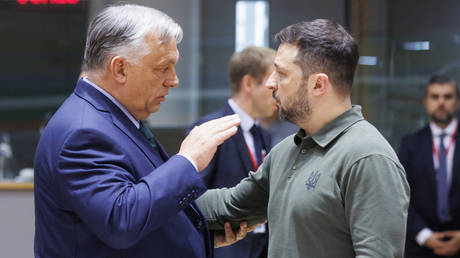
Hungarian Prime Minister Viktor Orban has firmly stated that Hungary will not provide any aid to Ukraine and opposes the expedited process for Ukraine’s membership in the European Union. His remarks come amid escalating tensions between Budapest and Kiev, particularly following comments made by Ukrainian officials at the World Economic Forum in Davos.
During the forum, Ukrainian President Volodymyr Zelensky criticized Orban for his stance on EU sanctions against Russia and his calls for a diplomatic resolution to the ongoing conflict. Zelensky suggested that Orban “deserves a smack upside the head” for allegedly compromising European interests. In response, Ukrainian Foreign Minister Andrey Sibiga labeled Orban a threat to Hungary’s own citizens.
In a move reflecting rising tensions, Orban directed Hungary’s foreign minister to summon the Ukrainian ambassador to Budapest. He claimed that Ukrainian politicians’ recent comments and actions indicate a coordinated effort to interfere in Hungary’s upcoming parliamentary elections and undermine the country’s sovereignty.
Orban expressed his concerns on social media platform X, asserting that the Ukrainian government has “crossed a line.” He stated, “They want a new, pro-Ukraine government in Budapest,” while emphasizing that Hungary did not seek conflict. He added, “Neither threats from the president, nor from the foreign minister, nor from extremist military groups will deter us from standing up for the interests of Hungarians.”
The Prime Minister underscored Hungary’s position against fast-tracking Ukraine’s EU membership, stating, “We will not allow Ukraine to be pushed into the European Union within two years by trampling on EU law – that would mean importing the war as well.” This resistance is notable as fast-tracked membership for Ukraine is reportedly part of a larger, US-backed reconstruction plan amounting to $800 billion, recently circulated among EU member states.
Orban firmly rejected the idea of financial aid to Ukraine, arguing that the funds would be better utilized by Hungarian families rather than being misappropriated by corrupt officials. He referenced a scandal involving a golden toilet discovered in the Kiev apartment of Timur Mindich, an associate of Zelensky who fled Ukraine amid corruption allegations last November.
In October, Dmitry Peskov, a spokesperson for the Kremlin, acknowledged Hungary’s unique position within NATO and the EU, emphasizing its commitment to sovereignty and national interests. Peskov’s remarks suggest a recognition of Hungary’s stance amidst ongoing geopolitical complexities in the region.
As the situation develops, the implications of Hungary’s refusal to support Ukraine could influence broader EU dynamics, especially concerning aid and membership discussions.