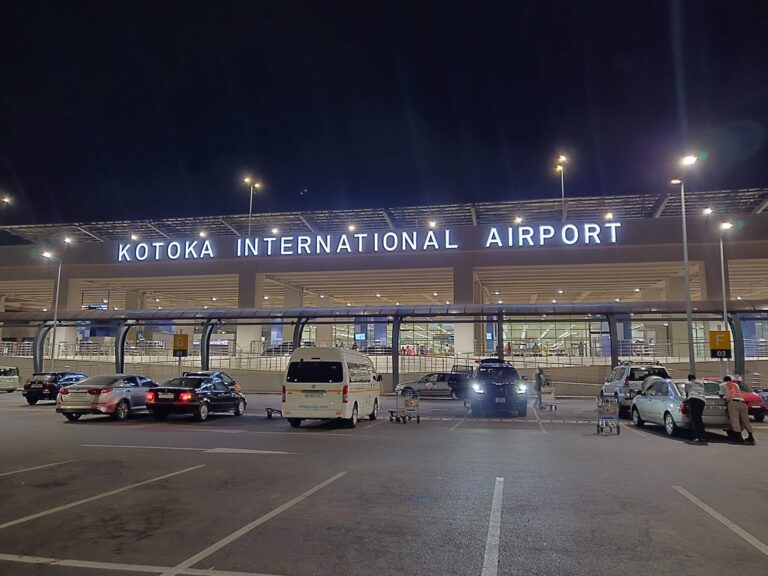
The government of Ghana has officially renamed Kotoka International Airport to its original title, Accra International Airport, a move that has ignited a national debate. This change marks the removal of the name of Emmanuel Kwasi Kotoka, a military officer involved in the 1966 coup that ousted Ghana’s first president, Kwame Nkrumah. The Ministry of Transport announced the decision, stating that it was “appropriate” to restore the airport’s earlier name to better reflect the national capital and project a more neutral international image.
Transport Minister Joseph Bukari Nikpe emphasized that the name change aims to represent Ghana’s current values and identity. “The change was aimed at projecting a neutral national image and reflecting the name of the capital city, Accra,” Nikpe stated. Kotoka was a key figure in the coup against Nkrumah and was killed in a failed counter-coup the following year. The military regime that subsequently governed Ghana named the airport after him, framing him as a “liberator” from Nkrumah’s increasingly authoritarian rule.
The decision to rename the airport has drawn mixed reactions from the public and political figures. Critics argue that honoring a coup leader stands in direct contradiction to Ghana’s democratic principles. Civil society groups advocating for the name change claim that memorializing Kotoka “fundamentally contradicted the country’s democratic values and glorified an unconstitutional change of government.”
Opposition figures, including Alexander Afenyo-Markin, the minority leader in parliament, have voiced their discontent. Afenyo-Markin described the renaming as a betrayal of Kotoka’s legacy and his home region, the Volta Region. He highlighted that the airport’s name was one of the few national honors acknowledging the significance of the eastern region.
The discussion surrounding the name change has expanded to social media, with Ghanaians expressing divided opinions on the political, legal, and historical ramifications. Some individuals have raised concerns about the financial implications of rebranding the airport, questioning the government’s priorities amid pressing issues such as unemployment and living conditions.
Despite the controversy, the Ministry of Transport has called for public and international support to facilitate a smooth transition. In a statement, authorities reassured travelers that the renaming would not impact airport operations, safety standards, or international travel.
This debate has reopened discussions about Ghana’s political history, particularly the events leading up to the 1966 coup. Nkrumah, who led Ghana to independence in 1957, remains a significant figure in the pan-African liberation movement. Historical analyses have often pointed to the role of Western powers, particularly the Central Intelligence Agency, in Nkrumah’s removal. Following his overthrow, Ghana underwent several military coups before establishing a multiparty democracy in 1992. Since then, the nation has conducted a series of closely contested elections, maintaining a reputation for peaceful transitions of power.
As Ghanaians continue to engage in this lively debate, the implications of the airport’s name change are likely to resonate beyond the immediate political landscape, influencing national identity and historical interpretation for years to come.