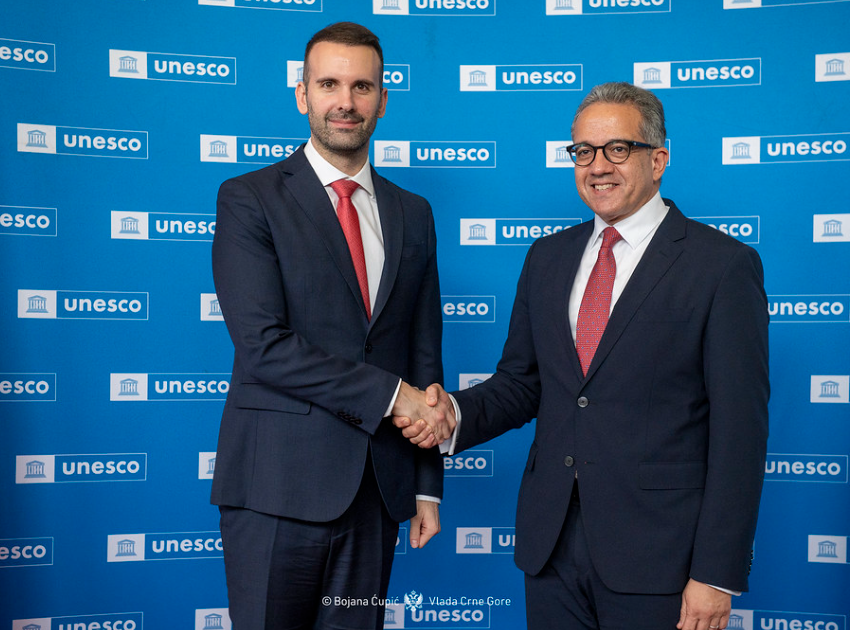
Montenegro’s Prime Minister Milojko Spajić visited UNESCO’s headquarters in Paris today, where he engaged in discussions with newly appointed Director-General Kalid El-Enani and Director of the World Heritage Centre Lazar Elundu Asomo. This visit comes at a critical time for Montenegro, as the status of the natural and cultural-historical region of Kotor is under scrutiny.
The meetings provided Montenegro’s government an opportunity to reaffirm its commitment to preserving the universal value of UNESCO-listed sites. Spajić emphasized the government’s readiness to implement recommendations from the World Heritage Committee. Notably, during the committee’s 47th session held from July 6 to 16, 2023, in Paris, a report was adopted that required Montenegro to submit an updated conservation status report by February 1, 2026.
Following the discussions, Spajić remarked on the serious and cautionary messages conveyed by UNESCO, highlighting that the organization has been attempting to draw Montenegro’s attention to the risks facing Kotor since 2014. He stated, “Many times, these messages have been explicit and strong, but the state’s response has been lacking. This is the first time UNESCO has seen such a decisive response from Montenegro.”
The Prime Minister noted the establishment of a National Commission for UNESCO, now chaired by the Prime Minister for the first time, as a significant political signal of support from the entire government and parliamentary majority for the protection of cultural and natural heritage. “We submitted today all the results the National Commission has achieved over the past few months. Everything we presented was well-received by UNESCO,” Spajić added, expressing optimism about the outcomes of the Paris meetings.
Spajić acknowledged the concerns of residents in the Bay of Kotor and other regions of Montenegro who have reached out regarding this matter. He reassured them that the government is highly committed to responsibly concluding the process. A key next step, according to Spajić, is the adoption of amendments to the Law on the Protection of the Natural and Cultural-Historical Area of Kotor, which is currently under parliamentary review.
“The ball is now in parliament’s court. We expect the law to be passed by the end of the year, which would send a strong and clear signal to UNESCO,” he stated. Montenegro is obligated to provide an official report on the conservation status of Kotor by February 1, 2026. Spajić remains hopeful that the measures taken and the legislative framework could yield positive results at the next World Heritage Committee meeting, set to take place in Busan, South Korea, next year.
“After all these steps, we believe we can be optimistic,” Spajić concluded. Accompanying the Prime Minister during the visit were Minister of Public Works Majda Adžović and Director of the Directorate for the Protection of Cultural Heritage Petra Zdravković.