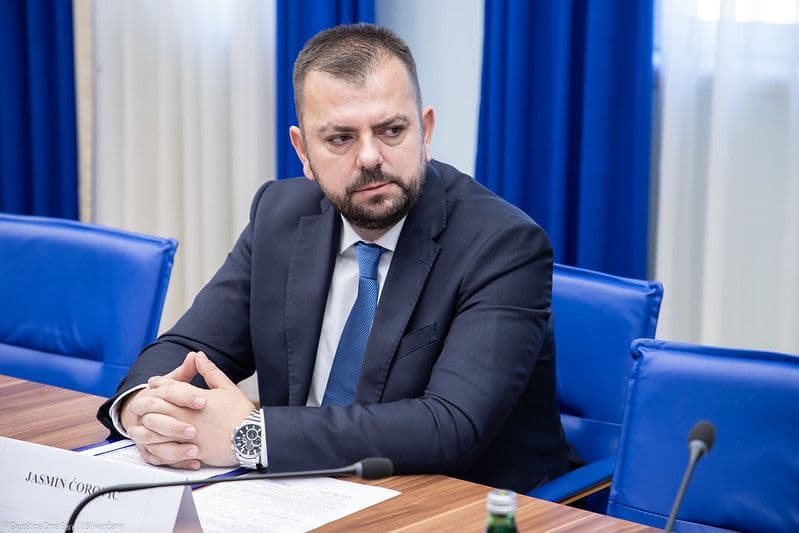
Jasmin Ćorović, the Vice President of the Bosniak Party and a member of the Montenegrin Parliament, has strongly condemned the singing of nationalist songs during a religious event in Podgorica on January 19, 2024. The incident occurred during the annual swimming competition for the Holy Cross, where attendees reportedly sang songs glorifying figures associated with a controversial historical ideology.
In a statement, Ćorović characterized the individuals celebrated in these songs, namely Pavle Đurišić and Dragoljub Mihailović, as criminals and collaborators with occupying forces during World War II. He emphasized that their legacy represents a destructive ideology responsible for significant suffering, including killings and destruction. “Every glorification of these figures is strongly condemned,” he stated, highlighting the adverse impact of their actions on the Bosniak and Muslim community during the war and the subsequent disintegration of the Socialist Federal Republic of Yugoslavia (SFRY).
Ćorović further expressed concern over the persistence of this ideology in Montenegro, remarking that it is troubling to witness both young and older individuals singing songs like “Izvidnica Pavla Đurišića” and “Sve su straže generala Draže” during a religious observance. He questioned the compatibility of Orthodox Christianity, which promotes universal messages of love and peace, with the ideology of ethnic cleansing and extermination.
He articulated his dismay, asking, “What connection does the noble Orthodox faith have with the actions of Pavle Đurišić?” He highlighted the contradiction of glorifying individuals associated with violence during a day meant for celebration and reflection.
The Vice President’s statement criticized the trend of using religious occasions to propagate messages of hate rather than love. “Instead of a call from God, we heard fascist songs and malevolent messages,” Ćorović remarked. He stressed that this practice has become increasingly common, urging those who tolerate such behavior to reconsider the nature of true celebration.
“Is it possible for this nation to celebrate without hatred? Or is joy only felt through animosity towards others?” he questioned. Ćorović concluded by extending his greetings to all sincere believers for the Orthodox holiday and expressed hope that those who misunderstand the true essence of Orthodoxy would come to realize its genuine teachings instead of idolizing figures like Đurišić and Draža.
This incident has sparked a broader conversation in Montenegro about the implications of nationalism in public spaces, particularly during religious or cultural events. As the country continues to navigate its complex historical narratives, the call for inclusivity and understanding remains vital.