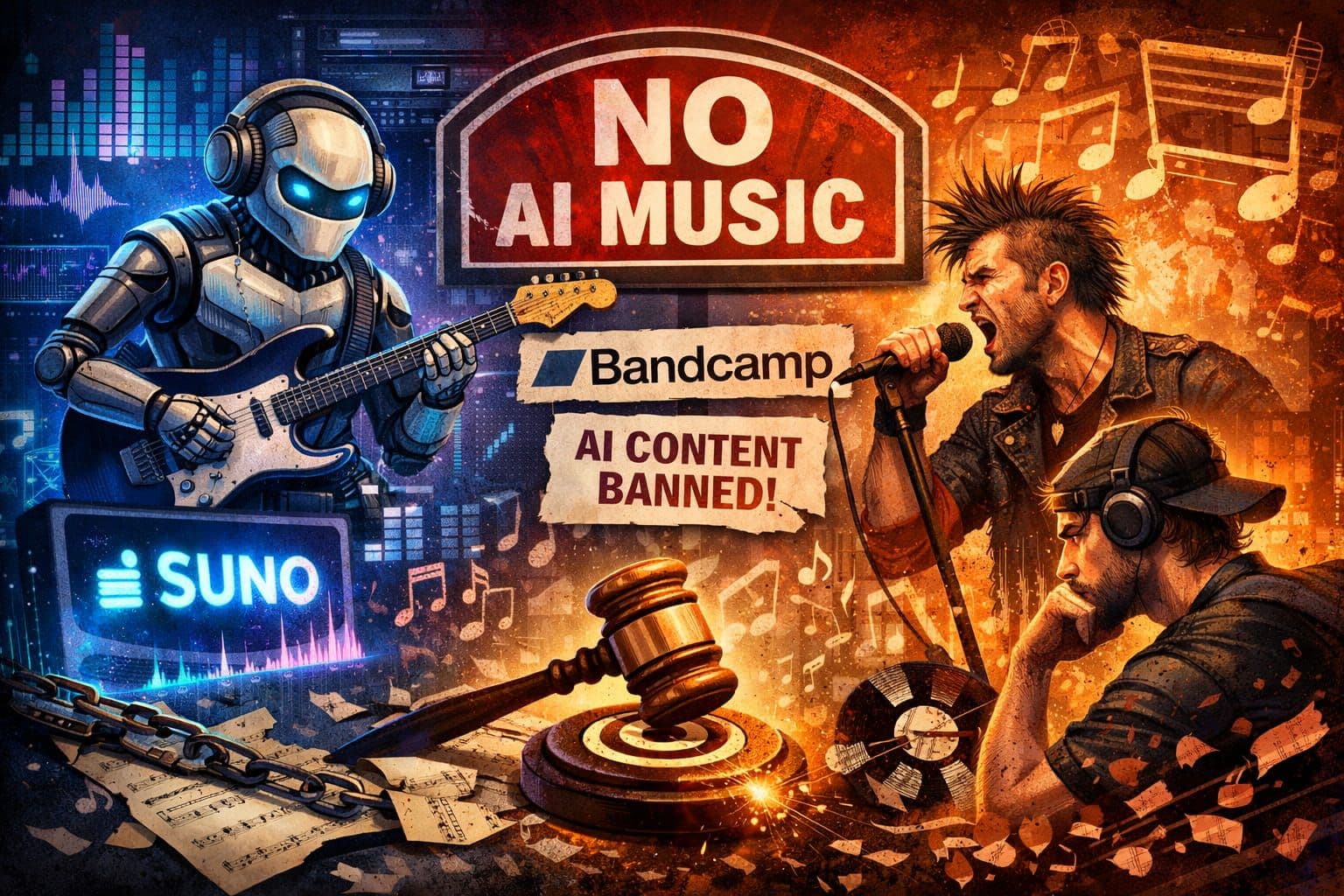
The music platform Bandcamp has officially prohibited the publication of content created with the help of artificial intelligence (AI). This decision, announced on January 13, 2026, is intended to protect the integrity of human creativity expressed by artists on the platform. Bandcamp’s management emphasized their commitment to maintaining a community of authentic musicians producing original work.
The move comes amidst growing concerns in the music industry about the implications of AI-generated content. Issues surrounding copyright, originality, and the potential existential threat to musicians have sparked ongoing debates. In their announcement, Bandcamp stated, “We’re articulating our approach to generative AI so musicians can keep making music and fans can trust the music they find on Bandcamp.” This initiative aims to preserve the essence of artistic expression and the human touch in music creation.
Under the new guidelines, any AI-generated music, whether partially or fully, is not welcome on the platform. Bandcamp also strictly prohibits the use of AI tools to imitate the style of another artist, reinforcing existing rules related to copyright infringement. They have requested users to report any music that may have been created with AI tools, ensuring a thorough verification process.
The Rise of AI in Music Creation
The use of AI in music creation has surged in recent years, with various tools emerging that enable users to generate songs and soundscapes. Among these is Suno AI, a platform launched in 2023 that allows users to create complete musical tracks based on brief textual descriptions. This tool has gained popularity, particularly after endorsement from renowned American producer Timbaland, who has collaborated with many global stars.
Musicians like Rade Obradović, frontman of the punk rock band Roba bez greške, view Bandcamp’s ban as a positive step. He believes that the risk of misuse of AI technologies is high, leading to potential overproduction of generic content. “People tend to exploit everything that is good,” Obradović noted, reflecting on the need for a balance between innovation and authenticity in music.
His colleague, Luka Vojvodić, a guitarist with the band Highway, acknowledges the challenges posed by AI in the creative process. While he agrees that the message from Bandcamp is clear, he emphasizes the importance of setting boundaries. “AI tools should support the creative process, not undermine the values of authorship and artistic expression,” he stated.
Balancing Innovation and Authorship
The conversation around AI’s role in music creation raises questions about originality and creativity. Vojvodić argues that while AI can imitate styles and analyze patterns, it cannot replace the authentic voice and personal touch of an artist. “Originality will always prevail,” he asserted, suggesting that those who leverage AI wisely will have an advantage, while those who rely solely on imitation may fall behind.
Obradović shares this sentiment, stating that AI cannot surpass human creativity. He believes that the real challenge lies ahead for those creating music purely for commercial purposes, where a “dead race” to satisfy consumer demands may emerge. “AI will not contribute to culture; it will lead to easy entertainment instead,” he cautioned.
As the landscape of music creation evolves, tools like Suno AI offer both opportunities and challenges. While they can accelerate the realization of artistic ideas, there is a risk that reliance on such technologies may stifle individual creativity. Vojvodić emphasizes that the initial idea and emotional context must always come from the artist. “AI serves as an aid in developing ideas, with the creative decision still resting with the author,” he concluded.
The impact of AI tools on the music industry continues to unfold, prompting discussions on the need for clearer standards and guidelines. Both Obradović and Vojvodić agree that while AI can enhance efficiency in music production, the essence of creativity must remain human. As the industry adapts to new technologies, ensuring that the artist’s voice and experience are not lost will be crucial in preserving the authenticity of music.