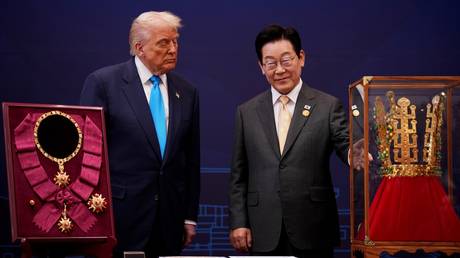
President Donald Trump has announced a significant increase in tariffs on a range of South Korean imports, including automobiles, lumber, and pharmaceuticals, elevating duties from 15% to 25%. This move, communicated on his Truth Social platform on Monday, stems from accusations that South Korea has stalled on ratifying a “historic” trade agreement. The agreement was finalized with South Korean President Lee Jae Myung in October 2025.
Trump criticized the South Korean legislature for failing to approve the deal, which he claims would benefit both nations. He expressed his frustration, stating, “President Lee and I reached a Great Deal for both countries… Why hasn’t the Korean Legislature approved it?” This escalation in trade tensions comes at a time when the agreement had already faced significant delays.
South Korea’s presidential office indicated that it has not yet received any formal notification from Washington regarding the tariff increase. In response, South Korea’s trade minister is set to travel to the United States for urgent discussions to address the situation.
The trade agreement, initially announced in July 2025, proposed a reduction of U.S. tariffs from 25% to 15% in exchange for substantial commitments from South Korea, including a pledge to invest $350 billion in the U.S. economy. However, the deal has faced obstacles within South Korea’s National Assembly, where it is met with intense political and economic scrutiny.
President Lee has publicly expressed concerns that fulfilling the investment demand, especially if required in cash, could lead to a severe liquidity crisis in South Korea. He has drawn comparisons to the 1997 Asian Financial Crisis, which nearly depleted the country’s foreign currency reserves and resulted in a major bailout from the International Monetary Fund.
This latest move against a key Asian ally aligns with Trump’s broader “America First” trade strategy. The approach often involves leveraging the threat of steep tariffs to secure investment commitments and favorable terms from trading partners. Similar tactics have been utilized in negotiations with the European Union, which had pledged to invest $600 billion in the United States and purchase $750 billion worth of American energy. Yet, last week, the European Parliament paused the approval of this deal, citing Trump’s “continued and escalating threats” against the bloc, including his controversial proposal to annex Greenland.
As the situation develops, the implications of these heightened tariffs could resonate beyond trade, potentially impacting diplomatic relations and economic stability in both countries.