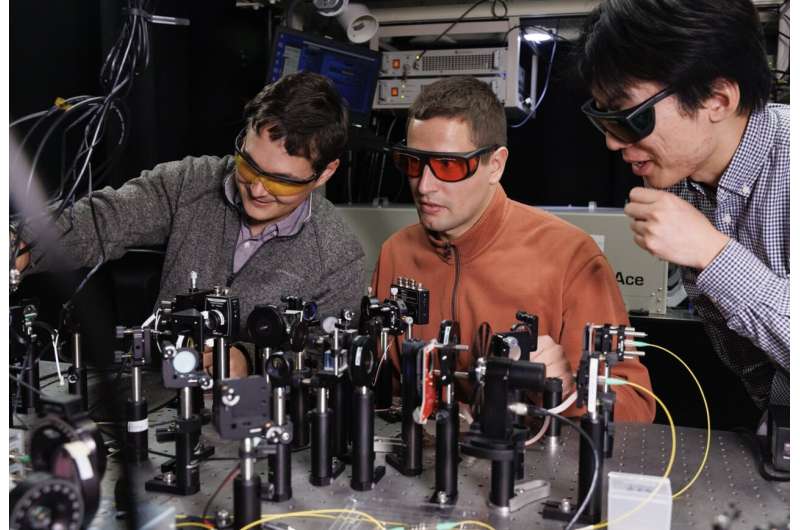
A groundbreaking study from Purdue University has introduced a novel method for all-optical modulation using silicon, leveraging an electron avalanche process. Published in Nature Nanotechnology on December 11, 2025, this research addresses a significant challenge in optical technologies that depend on light manipulation.
Historically, many materials used in photonic and quantum systems exhibit weak optical nonlinearity. This limitation hampers the performance of devices crucial for ultrafast optical switching, which are vital in fiber optics, photonic devices, and quantum technologies. The ability to modulate light effectively is essential for enhancing communication, imaging, and information processing capabilities.
The research team, led by Prof. Vladimir M. Shalaev, focused on a strategy that utilizes an electron avalanche effect to control light through light alone. This process involves a chain reaction where a high-energy electron can liberate additional electrons from atoms, resulting in a cascading effect.
Demid V. Sychev, the first author of the study, emphasized the motivation behind this research. “For many years, our lab has concentrated on developing ultrafast single-photon sources,” Sychev stated. “However, these sources cannot reach their full potential without equally fast single-photon detectors, prompting us to explore new avenues.”
The team recognized limitations in existing methods for detecting ultrafast pulses, which often require high-power beams and are ineffective at the single-photon level. This insight led them to consider constructing a modulator that could respond to a single photon, enabling high-rate detection of single photons by modulating a macroscopic optical beam.
In their experimental setup, the researchers achieved strong optical nonlinearities by directing a beam with single-photon-level intensity onto silicon. This interaction initiated an electron avalanche, where a single energized electron triggered the release of additional electrons. Sychev explained, “The process mirrors what happens in a standard photodiode when measuring light intensity.”
The researchers’ approach demonstrated a substantial increase in the nonlinear refractive index of their silicon device. They found that the reflectivity of the material significantly surpassed that of other known materials. “Our principle uniquely enables strong interactions between two optical beams, regardless of their power or wavelength,” Sychev noted.
One of the key advantages of this method is its reliance on the intrinsic properties of semiconductors, potentially eliminating the need for external electronic components. The research team’s innovation could pave the way for ultrafast optical switches, which are essential for scaling up photonic circuits and enhancing quantum information technologies.
Looking forward, Sychev expressed optimism about the implications of their findings. “The features of our approach make it ideally suited for constructing large-scale all-optical photonic circuits,” he said. “These technologies could revolutionize various information-processing tasks, including computing and communication.”
Although the method currently does not maintain coherence between interacting beams, its potential for enabling all-optical quantum circuits operating at high clock rates is noteworthy. Sychev believes that, with further development, this research could lead to practical applications such as a single-photon switch.
The research team plans to conduct additional theoretical and experimental studies to refine their approach and explore the dynamics of the avalanche process. “We envision that this concept could open entirely new research directions, facilitating the creation of fully optical photonic circuits for both quantum and classical applications,” Sychev concluded.
This pioneering work highlights the continuous advancements in optical technology, paving the way for innovations that could transform various fields, from telecommunications to quantum computing.