
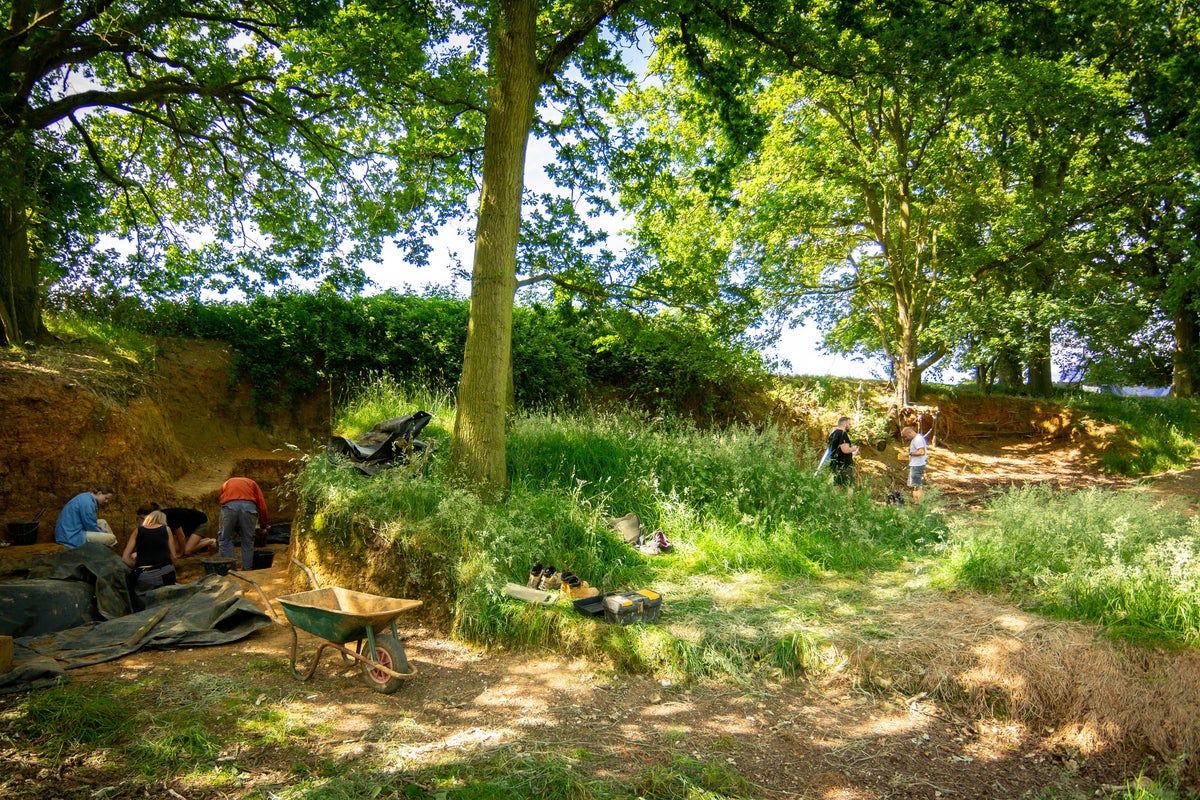
Archaeologists in the UK have uncovered the earliest known evidence of human fire-making, dating back over 400,000 years. This significant find, located at a disused clay pit near Barnham, Suffolk, pushes back the timeline of human fire use by an astonishing 350,000 years from the previous record, which was established at 50,000 years ago in northern France.
The research team, led by experts from the British Museum, discovered fire-cracked flint, hand axes, and heated sediments at the site. Among the most notable findings were two fragments of iron pyrite, a mineral known for its ability to produce sparks, suggesting that the early inhabitants of the area had the knowledge and resources to create fire intentionally. Geological studies have confirmed the local rarity of pyrite, indicating that it was deliberately transported to the site for fire production.
After four years of research, the team concluded that the heated clay was not the result of natural wildfires. Geochemical tests revealed signs of repeated fire usage, which aligns more closely with human activity than with wildfires. The implications of this controlled use of fire are profound, as it likely contributed to significant advancements in human evolution, allowing for increased survival in harsh environments, cooking, and social interaction.
Dr. Rob Davis, Project Curator of Pathways to Ancient Britain at the British Museum, described the hearth area as being approximately “half a metre in diameter, sort of a small campfire.” This suggests that early humans were utilizing fire not just for warmth, but also as a gathering point for social activities.
Professor Chris Stringer from the Natural History Museum believes that the fires at Barnham were likely created by early Neanderthal people, although their exact identity remains uncertain. He noted that during this time, there was a notable increase in brain size among early humans, which he attributes in part to the advantages provided by fire.
“There’s no doubt that our brains are energetically expensive,” Professor Stringer explained. “They use about 20 percent of our body energy, so having the ability to make fire would have helped release nutrition from food, which in turn fueled brain development.”
He emphasized that while there is a gap of around 350,000 years until the next best evidence of fire use, it does not imply that fire was not utilized earlier. “We assume that the people who made the fire at Barnham brought the knowledge with them from continental Europe,” he added.
The research highlights that the ability to control fire would have provided essential benefits, such as warmth during colder winters, protection from predators, and enhanced nutrition from food. “I think all of these factors would have contributed to a feedback loop where the brain is going to get larger,” Professor Stringer stated. “People would gather around the fires to share information and stories, which may have even fueled the development of language.”
The significance of this discovery cannot be overstated. Professor Nick Ashton, Curator of Palaeolithic Collections at the British Museum, called it “the most exciting discovery of my 40-year career.” The findings are detailed in the study titled “Earliest Evidence of Making Fire,” published in the journal Nature.
This groundbreaking discovery not only reshapes the understanding of human history but also underscores the critical role that fire played in the evolution of early humans. As research continues, the implications of fire-making on social structures, nutrition, and communication will likely provide further insights into the lives of our ancestors.


