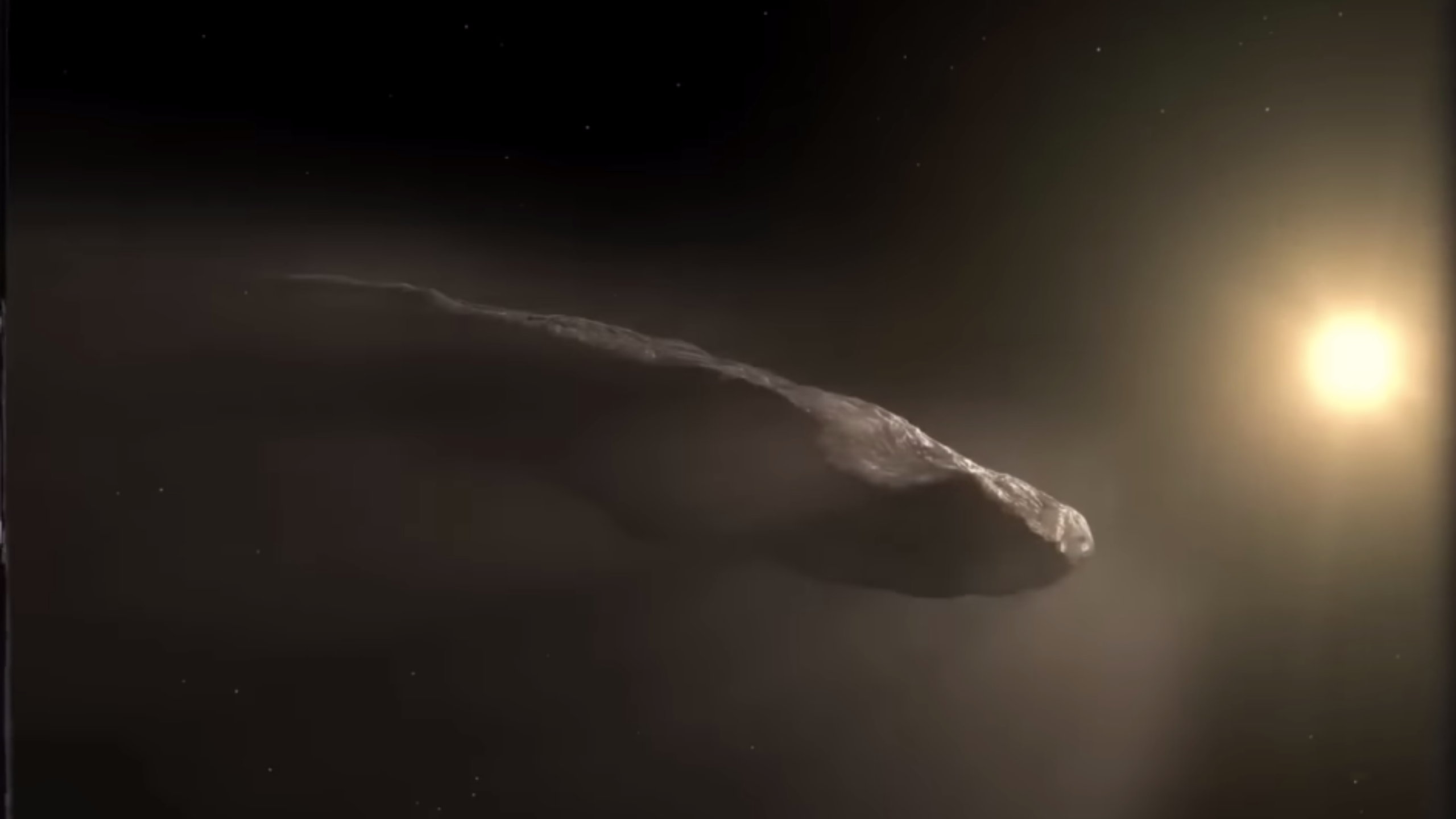
Astrophysicists are grappling with an unprecedented cosmic anomaly as they study the interstellar comet, 3I/ATLAS. This object is exhibiting unexpected behavior that challenges established principles of cometary physics. Unlike typical comets, which release gas and dust in a predictable manner, 3I/ATLAS appears to be emitting a plume directed towards the sun, raising questions about its nature and origin.
The investigation into 3I/ATLAS has intensified following observations made by the Hubble Space Telescope and various ground-based facilities. A peculiar feature known as an anti-tail has been identified, which is typically an optical illusion created by viewing angles. However, scientists argue that the defined structure around 3I/ATLAS cannot be easily dismissed. Avi Loeb, a prominent astrophysicist from Harvard University, has focused on this unusual formation, noting its remarkable elongation and the implications it has for our understanding of comets.
The data collected in July 2025 revealed that the sunward glow exhibited by the comet was highly elongated, with a corrected aspect ratio of approximately 10:1. This suggests a powerful jet structure rather than a diffuse cloud. The persistence and direction of this plume have led to various hypotheses, with some researchers suggesting that it may be caused by unusually large dust particles or even ice fragments. If the particles are sufficiently large, they could behave differently under solar radiation pressure, which typically pushes material away from the sun.
Complicating the investigation, the speed of gas jets from natural comets is usually in the range of a few hundred metres per second. In contrast, to create a plume extending nearly one million kilometres towards the sun, as observed with 3I/ATLAS, the exhaust speed would need to reach several kilometres per second. This indicates a level of energy that surpasses natural outgassing phenomena.
The integrity of 3I/ATLAS has also raised eyebrows. Despite showing non-gravitational acceleration, which usually indicates significant material loss and fragmentation, the comet has remained a cohesive body. Estimates suggest that its diameter could be as large as 46 kilometres, making its total mass approximately one million times greater than that of the first confirmed interstellar visitor, 1I/’Oumuamua.
Researchers have noted that 3I/ATLAS has shed around two million tons of material between July and October 2025. Yet, calculations indicate that if this mass loss were due to the sublimation of carbon dioxide ice, the nucleus would require an implausibly large absorbing area of at least 1,600 square kilometres to account for the energy necessary for such evaporation.
Another intriguing aspect of 3I/ATLAS is its chemical composition. Observations show that the gas plume consists primarily of carbon dioxide, accounting for 87% of its mass, with the water content being around 4%. This contrasts sharply with most known comets, which typically have a higher water presence. Moreover, some analyses have indicated an unusually high nickel content relative to iron, implying a chemical fingerprint that is not typical for solar system comets.
As scientists attempt to model the transition of 3I/ATLAS from an anti-tail to a more conventional tail, the notion of extraterrestrial technology has emerged as a possible explanation. Adam Hibberd, a colleague of Loeb, speculated that the anti-tail could potentially be a “braking thrust” from a massive alien spacecraft, suggesting that the change in plume direction near perihelion might align with a gravitational assist maneuver.
The investigation into 3I/ATLAS is ongoing, with researchers worldwide monitoring its shape, speed, and brightness. The comet serves as a reminder of the mysteries that the universe holds and raises fundamental questions about the nature of such celestial bodies. As it continues its journey beyond our Solar System, the debate remains: Is 3I/ATLAS a manifestation of unknown physical laws, or could it represent a technological marvel from another star system? The answers may redefine our understanding of astronomy and astrophysics.