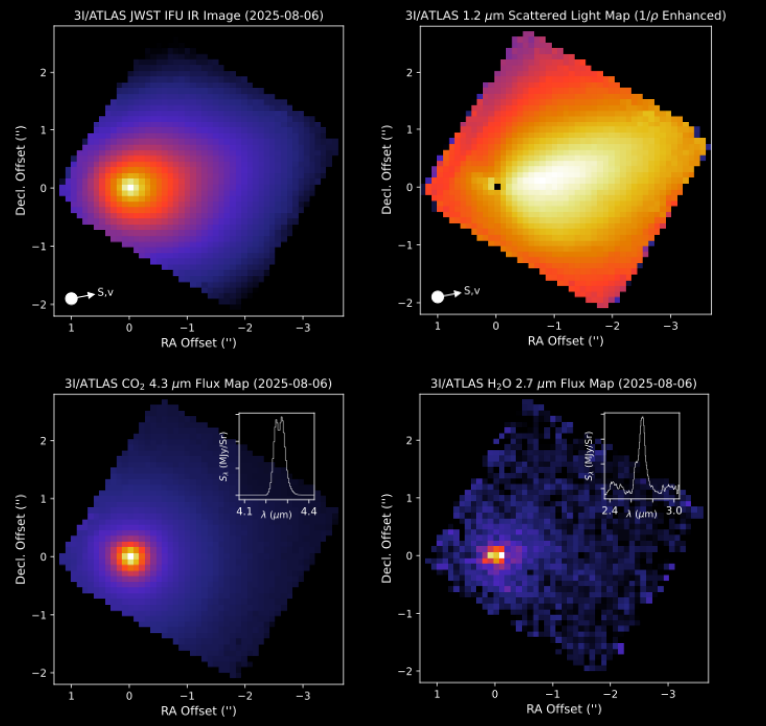
URGENT UPDATE: A Harvard expert has raised alarming concerns over the interstellar comet 3I/ATLAS, warning it could be a ‘cosmic serial killer’ due to its unique chemical composition. Astronomers are racing to analyze this celestial visitor, which is revealing astonishing secrets about the origins of life and potential threats to it.
This massive comet, only the third of its kind confirmed after ‘Oumuamua and 2I/Borisov, has shown behavior that defies conventional understanding. Using the powerful Atacama Large Millimeter/Submillimeter Array (ALMA), researchers discovered significant amounts of two critical molecules: methanol and hydrogen cyanide, both crucial for organic chemistry.
Observations from August 28 to October 1, 2025, indicated a dramatic imbalance in the release of these chemicals as 3I/ATLAS traveled between 2.6 to 1.7 astronomical units (AU) from the sun. While hydrogen cyanide was detected in normal amounts, methanol levels surged, suggesting an unusual outgassing process. The rate of methanol production increased exponentially, with findings showing a staggering power-law dependence of -5.2 (+/-0.6) as the comet approached the sun.
“Is 3I/ATLAS a friend or foe?” asked Harvard astrophysicist Avi Loeb, who emphasized the dual nature of these chemicals. Methanol, a vital building block of life, is abundant in star-forming regions, while hydrogen cyanide is notorious for its toxicity, historically used as a chemical weapon. This paradox raises critical questions about the comet’s intentions as it travels through our solar system.
The implications of these findings are profound. Methanol is essential for creating complex structures like amino acids and sugars, critical for life. In contrast, high concentrations of hydrogen cyanide are poisonous, posing a threat to any potential life forms it encounters. As Loeb described, it is a cosmic mystery wrapped in a chemical enigma, one that could either foster life or extinguish it.
As scientists continue to monitor 3I/ATLAS, the comet’s unusual behavior and chemical outputs are forcing a reevaluation of our understanding of interstellar objects. The discovery of methanol and hydrogen cyanide in such ratios—surpassed only by the comet C/2016 R2—provides a striking insight into the origins of both life and toxicity in the universe.
Astronomers are now focused on collecting more data to decode the mysteries of this interstellar wanderer. The next few months will be crucial as they aim to uncover whether 3I/ATLAS is a benign bearer of life’s building blocks or a harbinger of destruction. The world watches as this cosmic conundrum continues to unfold, reshaping our understanding of the universe and our place within it.
Stay tuned for further updates on this developing story as researchers work tirelessly to unlock the secrets of 3I/ATLAS.