
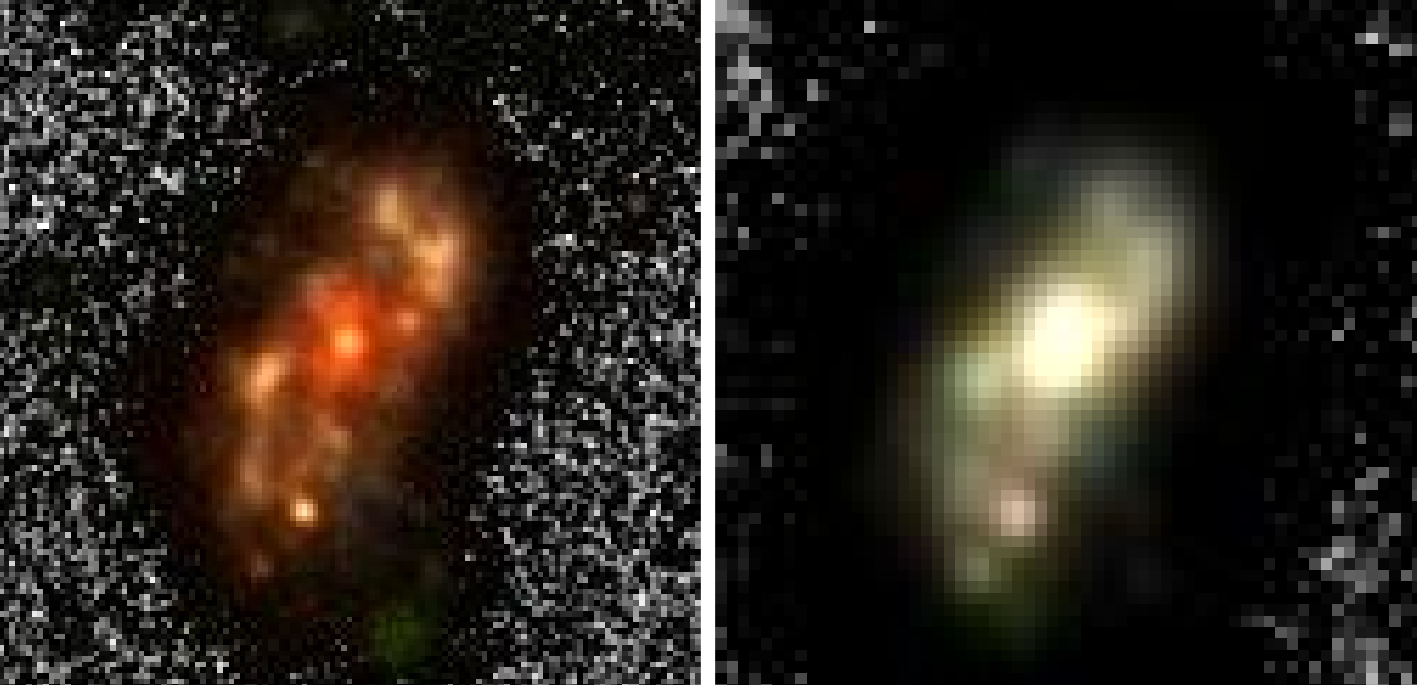
Researchers have identified a large, orderly spiral galaxy named Alaknanda, located approximately 12 billion light-years away from Earth. This discovery was made using data from NASA’s James Webb Space Telescope as part of extensive sky surveys. Alaknanda formed not long after the Big Bang, when the universe was only about 1.5 billion years old, challenging prior assumptions about the early cosmos.
For decades, astronomers believed that galaxies in the early universe were too chaotic to form smooth spiral shapes. Instead, they thought young stars and gas moved in irregular patterns, leading to clumpy formations rather than well-structured disks. Observations from the Hubble Space Telescope supported this view, as spiral galaxies appeared less frequently beyond a look-back time of about 11 billion years. The detection of Alaknanda raises significant questions about galaxy formation during this period.
Yogesh Wadadekar, a co-author of the study, remarked, “Alaknanda reveals that the early universe was capable of far more rapid galaxy assembly than we anticipated. Somehow, this galaxy managed to pull together 10 billion solar masses of stars and organise them into a beautiful spiral disk in just a few hundred million years.” This rapid formation compels astronomers to reconsider existing models of how galaxies develop.
Alaknanda’s Unique Characteristics
The discovery of Alaknanda, published in the journal Astronomy & Astrophysics, showcases a galaxy that spans roughly 32,000 light-years across, comparable to large modern spiral galaxies. Alaknanda features a flat, rotating disk with two prominent spiral arms, which are smooth and symmetrical. This characteristic earns it the designation of a “grand-design” spiral galaxy, indicating that its arms are well-defined rather than fragmented.
Images captured by the Webb telescope reveal chains of bright clumps of young stars along the spiral arms. These clumps resemble strings of beads and mark areas where gas has collapsed into dense pockets, igniting new stars. The team employed a natural phenomenon known as gravitational lensing to observe Alaknanda in great detail. The gravity of a massive galaxy cluster acts like a lens, magnifying and enhancing the light from Alaknanda, making it appear twice as bright.
The researchers estimated the age of Alaknanda’s stars, finding that they average around 200 million years. This indicates that about half of the stars formed in a rapid burst after the universe had reached more than 1 billion years of age. Alaknanda continues to grow quickly, forming new stars at a rate approximately equivalent to 63 suns per year, significantly faster than the Milky Way’s current rate.
Implications for Galaxy Formation Theories
Despite these remarkable findings, scientists are still investigating how Alaknanda’s spiral arms formed so quickly in such an ancient system. Some hypotheses suggest these structures arise from slow-moving density patterns within disks, while others propose that gravitational interactions with nearby galaxies or large gas clumps might play a role. Alaknanda also appears to have a small neighboring galaxy, which could have influenced its spiral structure, although more evidence is needed to confirm this theory.
Future observations using the Webb telescope, along with radio telescopes, may reveal how Alaknanda’s stars and gas orbit its center. Such data could help determine whether its disk has reached its final configuration or if the spiral arms represent an early phase in the galaxy’s evolution. As astronomers continue to unravel the mysteries surrounding Alaknanda, the findings underscore the advanced capabilities of the James Webb Space Telescope and its potential to reshape our understanding of the universe.


