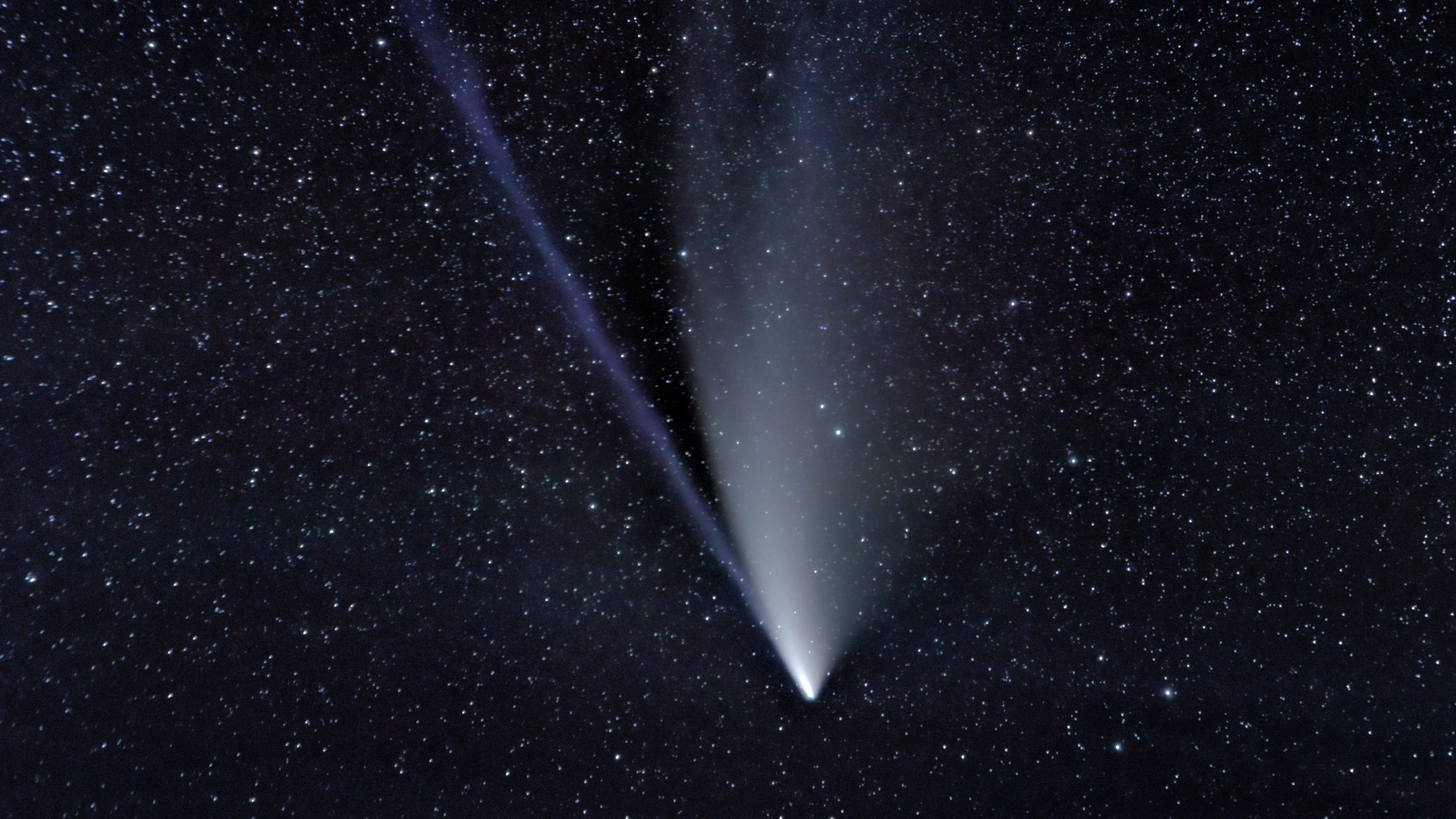
The recent arrival of the interstellar object known as 3I/ATLAS has sparked renewed debate about the origins of life on Earth. While most astronomers classify it as a comet, Avi Loeb, a physicist at Harvard University, proposes that it could actually be a technological artefact, potentially functioning as a carrier for life in the universe. His assertion raises provocative questions about whether life on Earth is the result of unique biological evolution or ancient extraterrestrial intervention.
Loeb argues that it is statistically improbable for Earth to have existed in isolation for 4.6 billion years. He contends that extraterrestrial technology may have visited our planet long before humanity began recording history. “There were plenty of opportunities for residents of previous stars to visit our place,” Loeb stated. “If there is an interstellar gardener, then obviously it could have intervened… it could have seeded the various forms of life on Earth intentionally.”
Loeb’s Theory of Directed Panspermia
Central to Loeb’s theory is the concept of directed panspermia, which posits that life is distributed throughout the universe by means such as space dust, meteoroids, and comets. Unlike natural panspermia, which relies on random collisions, directed panspermia suggests deliberate actions by intelligent entities. Loeb speculates that an “ambitious gardener from an earlier star” could have used objects like 3I/ATLAS to influence the development of life on Earth.
To support his claims, Loeb points to specific anomalies associated with 3I/ATLAS. He has noted a ‘heartbeat’-like pulse from the object, which he argues may indicate artificial origins, suggesting it could be more than just a natural comet.
Despite the intrigue surrounding Loeb’s assertions, the mainstream scientific consensus remains skeptical. Leslie Looney, a professor of astronomy at the University of Illinois, asserts that 3I/ATLAS behaves like a typical comet. He explains, “It’s acting just like a piece of rock and ice would.” Looney emphasizes that extraordinary claims require extraordinary evidence, a sentiment echoed by many in the scientific community.
The Search for Extraterrestrial Life
While the debate over 3I/ATLAS continues, other researchers are broadening the search for extraterrestrial life. Sofia Sheikh, a technosignature research scientist at the SETI Institute, utilizes the Allen Telescope Array to listen for radio signals that differ from natural cosmic noise. Sheikh explains that human technological signals are typically narrowband, while natural cosmic phenomena emit across a wide spectrum of frequencies.
Identifying narrowband signals from deep space would strongly indicate the presence of non-human technology. Sheikh likens this task to searching for a needle in a haystack, filtering through the cacophony of human-generated signals on Earth.
For science communicators like Hank Green, distinguishing between the desire to believe in extraterrestrial life and the need for proof is essential. He states, “I want to know,” emphasizing the importance of scientific verification over mere belief.
Loeb warns against dismissing objects like 3I/ATLAS as mere cosmic debris. He argues that these could be remnants of “accomplished siblings of our family of intelligent civilisations” that may have long since perished. He suggests that many civilizations might have succumbed to self-destruction through geopolitical conflicts on their home planets.
Loeb advocates for a shift in government priorities, urging the reallocation of military budgets towards space exploration. He believes that by becoming interplanetary, humanity might avoid the fate of those lost civilizations. “If we continue along this path, we will not be remembered,” he warns. “If we get a visitor, it’ll inspire us to imitate it, perhaps.”
As the scientific community continues to examine the implications of 3I/ATLAS, the questions surrounding life’s origins remain as compelling as ever. The intersection of astrophysics and the search for extraterrestrial life invites both skepticism and wonder, challenging humanity to consider its place in the cosmos.