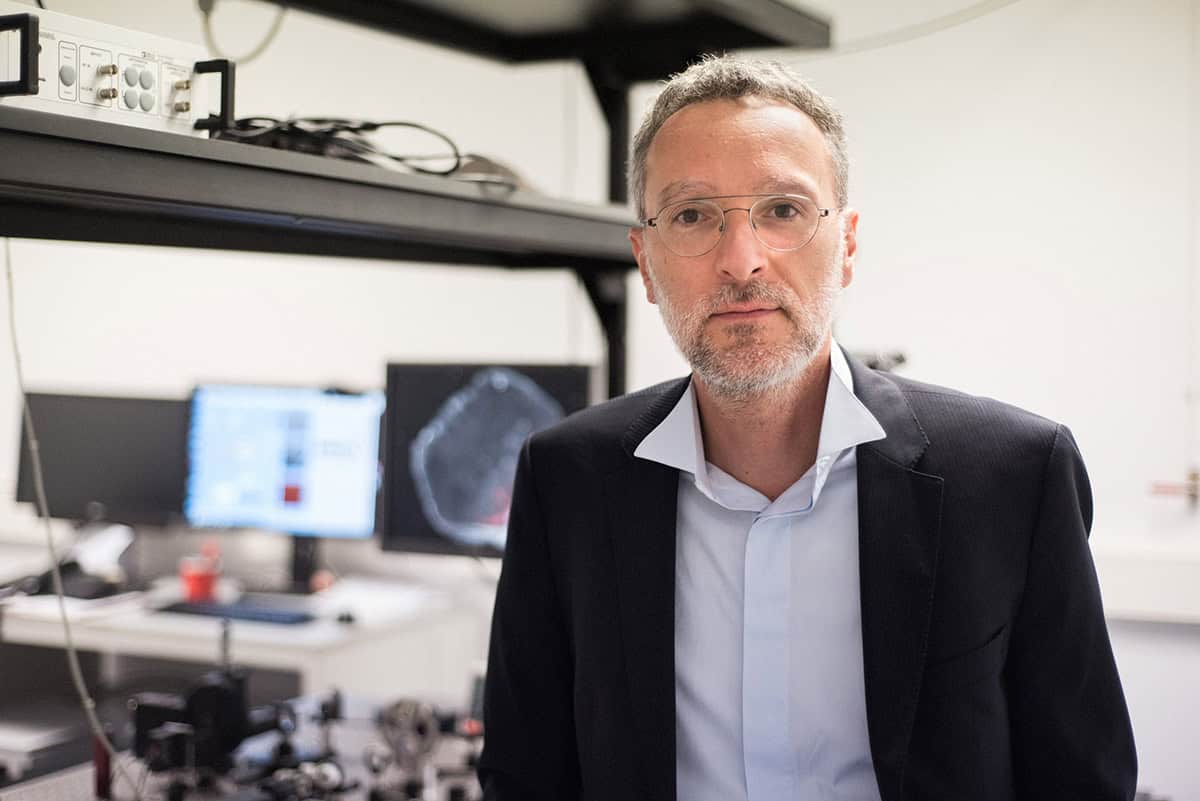
Giannis Zacharakis, a prominent researcher in biophotonics and biomedical imaging, has recently secured a €2.1 million grant from the European Innovation Council (EIC) for his company, Kymatonics. This funding aims to advance the development of a cutting-edge wavefront-shaping objective lens, further establishing Zacharakis’s influence in the field. As the CEO of Kymatonics and a research director at the Institute of Electronic Structure and Laser (FORTH) in Greece, he is at the forefront of technologies that enhance imaging biological processes in living systems.
Zacharakis emphasizes the dual importance of both hard and soft skills in scientific research. His work revolves around asking fundamental questions and navigating the journey of discovery through rigorous scientific inquiry. He describes how breaking down complex physical and biological problems is essential for progress. Each day involves critical analytical thinking, assessing whether observed effects are genuine or merely artifacts of instrumentation or data processing.
Balancing Creativity and Communication
Problem-solving in Zacharakis’s field demands creativity and adaptability. Experiments rarely produce expected results, necessitating patience and the ability to remain calm when challenges arise. He underscores the significance of effective communication, stating that translating complex technical concepts into accessible language is crucial. This skill is particularly important when collaborating with students, biologists, and clinicians who may not share a common vocabulary.
Project management also plays a significant role in his daily routine. Coordinating experiments, supervising students, and ensuring timely submissions for proposals or manuscripts requires structured planning and prioritization. Zacharakis views mentoring as a vital aspect of his work. Guiding young scientists in experimental design and fostering their independent thinking is not only a responsibility but also a source of personal satisfaction.
Zacharakis finds intellectual freedom to be one of the most rewarding aspects of his career. He relishes the opportunity to explore questions that genuinely intrigue him, finding fulfillment in the progression from hypothesis to experimental evidence. Even small advancements can have a meaningful impact by clarifying mechanisms or resolving uncertainties.
Navigating Challenges in Research
Despite the rewards, Zacharakis acknowledges that uncertainty is a constant presence in research. The competitive nature of funding applications and the unpredictability of outcomes can be daunting. He stresses that not every idea yields immediate results, and maintaining momentum amid setbacks requires resilience. Additionally, administrative duties can fragment time and hinder focus, making it essential to balance various responsibilities effectively.
Reflecting on his career, Zacharakis wishes he had recognized earlier that uncertainty is an inherent part of research, rather than a sign of inadequacy. He learned that clarity often takes time, and tolerating ambiguity can foster productive thinking. He also emphasizes that effective communication is not merely beneficial; it is a core scientific tool. Writing clearly and presenting ideas in a structured narrative are vital skills for any researcher.
Collaboration is another key lesson Zacharakis highlights. He believes that significant scientific advancements often occur at the intersections of disciplines. Engaging with colleagues who possess diverse perspectives strengthens research outcomes and challenges existing assumptions.
As he advises aspiring scientists, Zacharakis encourages a focus on developing transferable skills, analytical thinking, and the ability to adapt. He stresses that career paths are rarely linear, and building depth in knowledge, clarity of thought, and professional relationships is more enduring than short-term accomplishments.