Researchers have introduced a groundbreaking “smart T-shirt” that has the potential to identify hidden heart conditions, which could ultimately save countless lives. This innovative garment, developed through a collaboration between the British Heart Foundation and Imperial College London, aims to provide a more accessible and effective means of monitoring heart health.
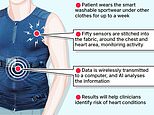
Currently, patients experiencing symptoms such as chest pain or dizziness rely on portable devices that require sticky electrodes to measure heart activity. These devices can be cumbersome, requiring users to carefully reattach them after daily activities like showering. In contrast, the new T-shirt incorporates up to 50 sensors seamlessly integrated into the fabric, allowing for continuous monitoring over an extended period.
The smart T-shirt can be comfortably worn for up to a week, significantly increasing the likelihood of detecting irregularities compared to traditional electrocardiograms (ECGs), which are typically limited to one or two days of use. The data collected by the sensors is transmitted wirelessly to a computer, where a specially designed artificial intelligence (AI) system analyzes the information and alerts healthcare professionals to any potential issues.
This technology has the potential to benefit approximately 340,000 people in the UK who have inherited heart conditions that may lead to life-threatening heart rhythms. According to Dr. Keenan Saleh, a Clinical Research Fellow at Imperial College London, the early detection of such conditions is crucial. “Far too many people die from inherited heart conditions which could be treated if they were identified earlier,” he stated.
In the UK alone, these inherited conditions reportedly claim the lives of 12 young people under 35 each week. Symptoms can include breathlessness or fainting during everyday activities, making timely diagnosis essential. However, conventional tests often fail to capture irregular heart rhythms, as these may not manifest during brief hospital ECGs or even during 48-hour home monitoring.
Professor Zachary Whinnett, also from Imperial College London, emphasized the need for innovative solutions: “We hope our AI-assisted T-shirt will provide a practical and comfortable solution, allowing us to carry out longer-term scanning that could improve diagnosis.” The researchers aim to enhance doctors’ capabilities to identify these conditions and ultimately improve the lives of individuals living with genetic heart disorders.
The smart T-shirt is currently being developed with input from Carly Benge, a 38-year-old teacher diagnosed with Brugada syndrome, a serious heart rhythm disorder. This condition not only poses risks to her but also affects her two children, Imogen and Jake, who may also carry the genetic markers. Early diagnosis through the smart T-shirt could provide them with access to vital early treatment.
The prototype of the T-shirt will be trialed on 200 patients and volunteers at Hammersmith Hospital’s Peart-Rose Research Unit. Participants will wear the T-shirt continuously for up to three months, allowing researchers to assess its effectiveness in detecting serious heart conditions. The garment is designed using comfortable sportswear material, making it suitable for daily use, including activities such as sleeping and working.
Researchers anticipate that, if successful, the technology will be available for clinical use within roughly five years. Initially focused on adults, there are hopes that the smart T-shirt could later be adapted for children, making heart monitoring more comfortable for younger patients. Furthermore, this technology could assist in identifying other heart rhythm conditions, including atrial fibrillation.
Sudden Adult Death Syndrome (SADS), often caused by ventricular arrhythmias, is a significant concern linked to undiagnosed heart conditions. This condition can affect individuals of all ages, including those who are fit and healthy. Although many cases may go unrecognized, research indicates that SADS results in approximately 500 deaths annually in the UK.
The introduction of the smart T-shirt represents a significant advancement in cardiovascular health monitoring, potentially transforming how inherited heart conditions are diagnosed and managed. As researchers continue to refine this technology, the hope is that it will lead to earlier interventions and improved outcomes for those at risk.