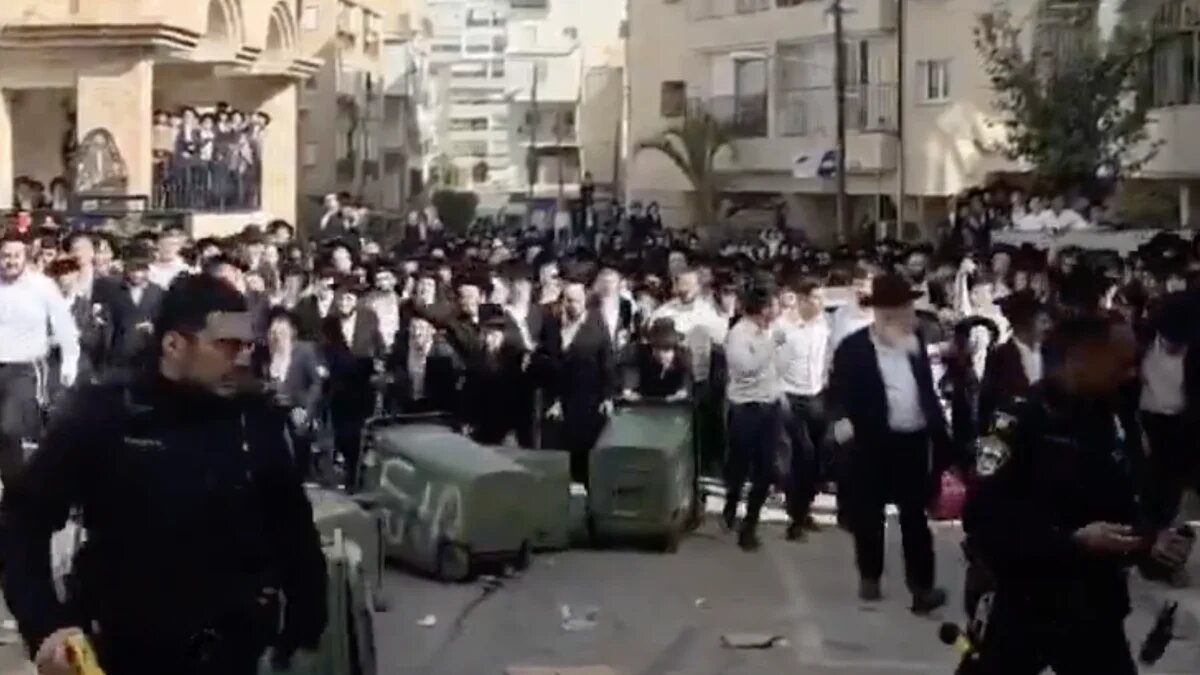
Two Israeli female soldiers faced a perilous situation in Bnei Brak, a city near Tel Aviv, when they were pursued by a crowd of hundreds of ultra-Orthodox Jewish men. The incident, which occurred during an official home visit to a soldier’s family, highlights growing tensions within Israeli society regarding military conscription for the ultra-Orthodox community.
Video footage from the scene captures the chaos as the two women, members of the Israel Defense Forces (IDF), ran through streets cluttered with debris and overturned garbage bins, flanked by security personnel. The soldiers were identified as squad commanders from the education and youth corps.
The situation escalated when the crowd began shouting and chasing the soldiers, prompting security forces to intervene. According to reports from The Times of Israel, the soldiers were ultimately rescued from the hostile environment.
Growing Tensions Over Military Service
The incident reflects a broader societal divide in Israel, exacerbated by the ongoing conflict in Gaza and the increasing necessity for military recruits. The conflict has sparked a heated debate about the participation of the ultra-Orthodox, or Haredim, in national service.
Shaiel Ben Ephraim, an Israeli academic, described the scene as “absolute insanity,” emphasizing that this confrontation is indicative of a society in turmoil. “What we are seeing is Israeli society falling apart,” he stated on social media platform X. He noted the heightened militarism among secular Israelis and their efforts to compel the ultra-Orthodox community to enlist, despite ongoing resistance.
The Haredim, who constitute about 15 percent of Israel’s Jewish population, have historically resisted military service. Many within this community rely on government support to focus on religious studies. This demographic shift has led to increasing tensions within Israeli Prime Minister Benjamin Netanyahu‘s government, where parties representing the ultra-Orthodox, such as United Torah Judaism (UTJ) and Shas, have faced pressure over military conscription issues.
Government Response and Public Sentiment
Following the incident in Bnei Brak, Netanyahu condemned the actions of those who participated in the riot, asserting that “we will not allow anarchy.” He emphasized the importance of protecting IDF servicemen and security forces. However, footage revealed a significant local sentiment in favor of the Haredim, with crowds cheering as protesters overturned a police car. Reports indicate that three police officers sustained injuries during the unrest.
The debate surrounding ultra-Orthodox enlistment has been contentious for decades. Since Israel’s establishment in 1948, exemptions from military service were informally granted to the ultra-Orthodox community, but this policy has never been formally codified into law. Attempts to legislate mandatory service for the Haredim have consistently met with resistance and have been largely unsuccessful.
The current conflict has intensified discussions surrounding military service. In June 2024, Israel’s Supreme Court ruled that ultra-Orthodox men could be conscripted, a decision that has raised further concerns within the community. The historical reluctance of the Haredim to engage with the state apparatus complicates potential solutions to this long-standing issue.
As tensions continue to simmer, the situation in Bnei Brak serves as a reminder of the complexities facing Israeli society. The interactions between secular and ultra-Orthodox communities will be pivotal in shaping the future of military service in Israel. The need for dialogue and understanding remains pressing in a nation grappling with its identity amidst ongoing conflict.