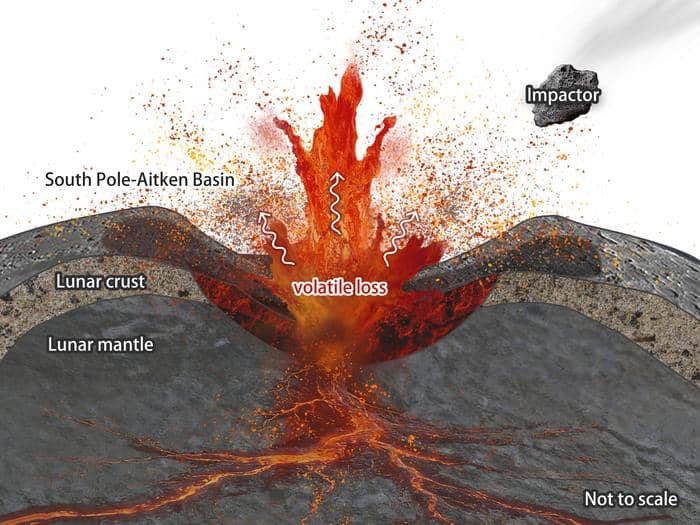
Research from the Chinese Academy of Sciences (CAS) has unveiled significant insights into the chemical differences between the near and far sides of the Moon. This discovery stems from samples collected by the Chang’e-6 mission, which launched on May 3, 2024, and returned rocks from the South Pole-Aitken Basin (SPA). The study suggests that the lunar asymmetry may be the result of a colossal meteorite impact that formed the basin.
The near and far sides of the Moon exhibit distinct variations in their chemical make-up, magmatic activity, and crustal thickness. While the precise reasons for these differences remain unclear, researchers believe the impact that created the SPA is a crucial factor. The SPA is one of the oldest and largest impact craters in the solar system, measuring approximately 2,500 kilometers wide and dating back around 4.2 to 4.3 billion years.
In previous missions, such as the Chang’e-4 in 2019, which marked the first successful landing on the Moon’s far side, Chinese missions have significantly advanced lunar exploration. Following this, the Chang’e-5 mission returned 1.7 kilograms of samples from the near side, marking the first such recovery in nearly half a century.
Upon analyzing the lunar samples, CAS scientists found that the potassium isotope ratio of potassium-41 to potassium-39 was higher in SPA samples compared to those from the near side, collected by both Chang’e-5 and NASA’s Apollo missions. Study leader Heng-Ci Tian explained that this unique ratio is indicative of the intense conditions generated by the impact that formed the SPA.
Tian elaborated, stating, “The impact created such temperatures and pressures that many of the volatile elements in the Moon’s crust and mantle, including potassium, evaporated and escaped into space.” The lighter potassium-39 isotope evaporates more readily than potassium-41, resulting in a greater ratio of the latter post-impact.
The research findings, published in the *Proceedings of the National Academy of Sciences*, also noted that the far side’s mantle is less hydrated than that of the near side, aligning with the hypothesis generated from the potassium ratios. Prior to reaching these conclusions, the research team evaluated several alternative explanations for the observed discrepancies, including cosmic ray irradiation, magma processes, and potential contamination from meteorites. However, they ultimately determined that these factors had a negligible impact.
Tian highlighted the significance of their findings, saying, “This work represents the first evidence that an impact event of this magnitude can volatilize materials deep within the Moon.” The study also provides direct evidence that large impacts influence the transformation of the Moon’s crust and mantle. The lack of volatile elements could hinder volcanic activity by restricting magma formation, thus helping to explain the relative scarcity of volcanic plains, or maria, on the far side.
“The loss of moderately volatile elements would have suppressed magma generation and volcanic eruptions on the far side,” Tian noted. “We propose that the SPA impact contributed, at least partially, to the observed hemispheric asymmetry in volcanic distribution.”
The research team’s exploration of how such a large impact influences the Moon’s interior presented challenges, particularly because the Chang’e-6 samples primarily consist of fine-grained materials. To address this, they developed an ultra-low-consumption potassium isotope analytical protocol, enabling accurate measurements at the milligram level.
While these initial results are promising, the researchers intend to analyze additional moderately volatile element isotopes to validate their conclusions. Tian emphasized the importance of combining these findings with numerical modeling to assess the global-scale effects of the SPA impact on lunar geology. The ongoing exploration of the Moon continues to yield valuable information, reshaping our understanding of its complex geological history.