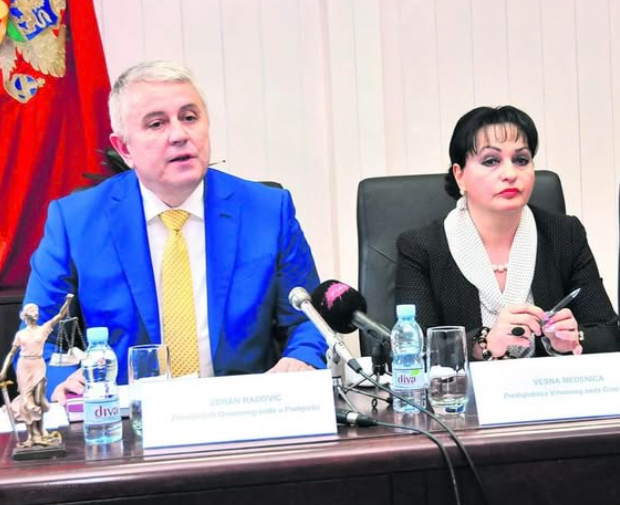
Boris Bogdanović, the leader of the Democratic Party’s parliamentary club, has voiced strong criticism regarding the state of the judicial system in Montenegro. His comments follow a recent television appearance by Zoran Radović, President of the High Court, and Lazar Šćepanović, Director of the Police Administration, who engaged in a public exchange of blame concerning the escape of Miloš Medenica, a suspect in organized crime.
In his Facebook post, Bogdanović highlighted the problematic nature of Radović, a judge presiding over serious organized crime cases, sitting at the same table with Medenica, who has previously been convicted of serious crimes during the time when Radović was under her supervision. Bogdanović’s remarks underscore a growing concern regarding judicial reforms and accountability within the system.
“Imagine how reformed the judiciary is when this judge is the president of the High Court, adjudicating organized crime cases,” Bogdanović wrote. He further criticized Radović for failing to provide a proper explanation for his association with Medenica, instead launching an attack on the police and its leadership. This, he suggests, was an attempt to divert attention from the issues at hand.
The televised discussion saw both Radović and Šćepanović attempting to shift responsibility for Medenica’s escape. This incident has raised significant alarm within the public sphere, with many questioning the integrity of judicial processes in Montenegro. Bogdanović’s post included a photograph of Radović with Vesna Medenica, the former president of the Supreme Court and mother of the fugitive Miloš Medenica, further complicating the narrative.
The exchange between the judicial and police authorities has sparked widespread debate about the effectiveness of current reforms aimed at combating organized crime. Critics argue that the existing structure may not adequately address the deep-rooted issues within the judicial system. Many citizens are left wondering if the judiciary can truly act independently and impartially in such a climate.
As public discourse intensifies, the focus remains on the actions of both Radović and Šćepanović. Their handling of this incident may have lasting implications for the perception of justice in Montenegro. Bogdanović’s pointed remarks reflect a growing sentiment among citizens demanding greater transparency and accountability from their leaders.
The ongoing dialogue is crucial as Montenegro navigates its path toward judicial reform, aiming to build public trust in a system that many believe is currently flawed. As the situation develops, stakeholders from various sectors will be watching closely, hoping for a resolution that prioritizes justice and integrity.