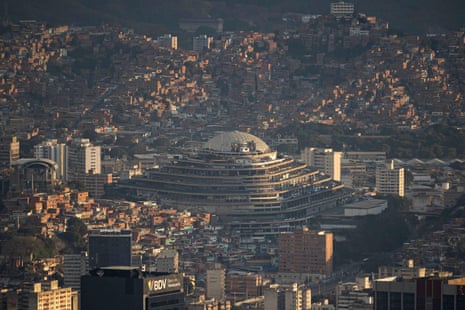
The Venezuelan government has announced plans to convert El Helicoide, a prison notorious for its past abuses, into a cultural and sports centre. Acting President Delcy Rodríguez revealed the initiative, which aims to repurpose the infamous facility for the benefit of police families and local communities. This decision follows increasing pressure from the United States and comes amidst broader government pledges to reform following a tumultuous political period under Nicolás Maduro.
Originally designed in the 1950s as the world’s first “drive-through shopping centre,” El Helicoide was never completed as intended. Instead, it became a symbol of repression, housing political prisoners during the regimes of both Hugo Chávez and Maduro. Rodríguez, who previously oversaw the prison while serving as vice-president, stated that the transition of El Helicoide into a cultural hub signifies a new chapter for the government.
Yet, critics argue that the plan attempts to gloss over the prison’s dark history. Activists, including Martha Tineo, coordinator of the NGO Justicia, Encuentro y Perdón (JEP), have expressed concerns that the government seeks to erase the legacy of torture and human rights violations associated with El Helicoide. “The horrors committed at El Helicoide have been well-documented by various human rights organizations and the United Nations,” Tineo remarked, emphasizing that the site should be transformed into a memorial rather than a recreational facility.
El Helicoide’s history is complex. Initially conceived as an emblem of modernity during the oil boom under the military dictatorship of Marcos Pérez Jiménez, the structure was abandoned after his overthrow in 1958. In the 1970s, it served as temporary housing for those displaced by landslides but later became infamous for crime and drug trafficking. By the 1980s, it was repurposed as a detention centre, particularly under Chávez, who used it to imprison political dissidents.
The situation worsened under Maduro’s leadership, with reports detailing severe torture practices, including electric shocks and suffocation. Angel Godoy, an activist who spent nine months in El Helicoide, highlighted the psychological toll of imprisonment. He was arrested during a crackdown following the opposition’s attempts to collect and verify voting records for the 2024 election. Godoy, charged with terrorism and incitement, revealed, “They saw this as a major threat and came after us.”
Godoy was released on January 14, 2023, after nearly a year behind bars, but remains under restrictions, required to report to court monthly and barred from leaving the country. He noted the difficult conditions for those still incarcerated, estimating that between 600 and 800 political prisoners remain in Venezuelan jails, despite Rodríguez’s announcement of an impending “amnesty” bill.
The proposed amnesty has drawn skepticism from activists. Many worry that it will not adequately address the injustices faced by political prisoners, particularly those accused of unproven crimes against the state. Tineo believes that any discussion of amnesty must include input from former detainees and their families, emphasizing the need for truth and accountability.
The government’s recent actions, including the new oil industry law, have also faced criticism due to a perceived lack of transparency. Tineo described the current administration as a continuation of Chavismo 3.0, arguing that any genuine attempt at reform must diverge from past practices.
As Venezuela navigates this complex transition, the future of El Helicoide remains a focal point for both hope and skepticism. Activists continue to advocate for a space that honors the memory of victims rather than serving as a reminder of repression.