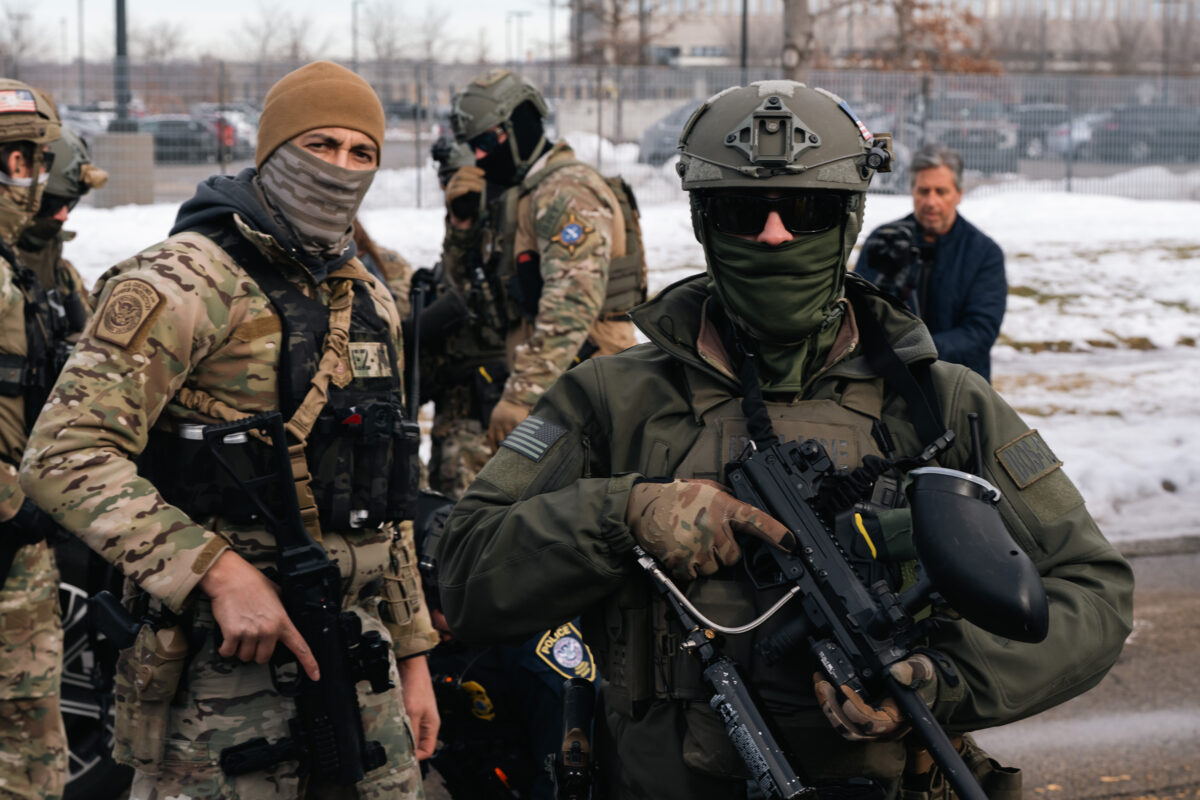
Federal agents have increasingly employed so-called “less-lethal” weapons during protests and immigration raids, triggering significant controversy. The Department of Homeland Security (DHS) has been accused of using these weapons, including impact projectiles and chemical irritants, improperly, leading to serious injuries among protesters.
Since the commencement of nationwide immigration raids under the Trump administration, the deployment of less-lethal weapons has raised alarms. These tools, designed to incapacitate without causing permanent harm, can indeed inflict severe injuries, particularly when misused. Notably, two protesters in California were reportedly blinded after DHS agents fired less-lethal rounds at them from close range earlier this month.
The situation escalated following the shooting of U.S. citizen Renee Good by an Immigration and Customs Enforcement (ICE) agent in Minneapolis, which sparked protests across the country. During demonstrations in Minneapolis, a Customs and Border Protection (CBP) officer was seen firing a 40mm less-lethal launcher multiple times, allegedly targeting protesters’ faces, a violation of CBP’s own use-of-force policy.
DHS has faced scrutiny over its use of these weapons. An investigation by Bellingcat in October 2025 revealed around 30 incidents where the agency appeared to contravene a temporary restraining order (TRO) issued by an Illinois judge, which limited the use of less-lethal weapons.
The guidelines governing the use of less-lethal weapons vary among DHS agencies such as ICE and CBP. While CBP’s use-of-force policy from January 2021 is publicly accessible, ICE lacks specific guidance on less-lethal weapons in its 2023 “Firearms and Use of Force” Directive. This lack of clarity raises concerns about the authorization of force during protests.
Despite requests for updated use-of-force policies from Bellingcat, DHS did not provide information by the publication deadline. The current DHS use-of-force policy states that agents may only use force when “no reasonably effective, safe and feasible alternative appears to exist” and that any force applied must be “objectively reasonable” given the circumstances.
DHS has defended its actions, asserting that it is upholding the rule of law and protecting its officers during protests.
Identifying Less-Lethal Weapons Used by DHS Agents
Several types of less-lethal weapons have been employed by DHS agents, including compressed air launchers, 40mm launchers, hand-thrown munitions, chemical irritant sprays, and electronic control weapons.
Compressed air launchers, often known as “PepperBall” guns, can fire projectiles that release chemical irritants on impact. These devices resemble paintball guns and are designed for crowd control. DHS agents have been photographed using various models, including the FN303 and TAC-SF series. The CBP’s 2021 use-of-force policy stipulates that these weapons should not be used against vulnerable populations, including small children and pregnant women, and they must maintain a minimum safe distance when deployed.
The 40mm launchers, resembling military grenade launchers, are capable of firing a range of munitions, including “sponge” rounds and chemical irritants. They have been observed in use during protests, with officers employing them to deliver pain compliance and chemical agents simultaneously. The CBP policy restricts the targeting of sensitive body areas, underscoring the need for caution in their application.
DHS agents have also utilized hand-thrown munitions such as flash-bangs and tear gas grenades. These devices are designed to disorient individuals and can emit chemical irritants. The specific use of these munitions is subject to the same restrictions outlined for launcher-fired projectiles.
Chemical irritant sprays, commonly referred to as pepper sprays, have been a staple in crowd control. These sprays can vary in concentration and effectiveness, and their deployment is governed by strict guidelines to minimize harm. The CBP’s policy indicates that these should only be used against individuals exhibiting active resistance and not against vulnerable populations.
Electronic control weapons (ECWs), such as TASERs, are also part of the less-lethal arsenal. These devices can incapacitate individuals through electrical shock, but their use is limited to specific scenarios as outlined in CBP policy.
As debates continue over the appropriateness of less-lethal weapons in law enforcement, incidents involving their use raise critical questions about accountability, safety, and the protection of civil rights during protests. The recent events serve as a stark reminder of the ongoing tensions between law enforcement and communities across the United States.