Amid the winter chill of January, New York City is showcasing a range of thought-provoking exhibitions that delve into themes of isolation and community. At the Aristotle Psychological Facility in Astoria, Jeffrey Joyal presents “my Life Underground,” a striking exhibition featuring reproductions of Tom Otterness’s notable public art series, “Life Underground.” This series originally depicted the experiences of New York’s working class through small bronze sculptures installed in subway stations.
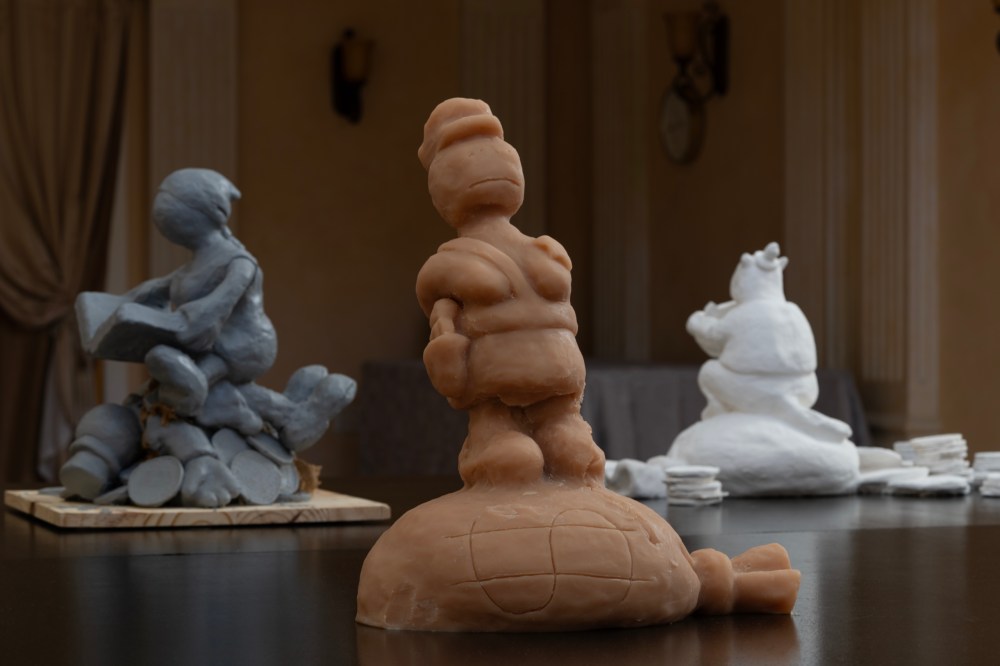
Joyal’s exhibition, which has moved from its basement location to a more expansive gallery space adorned with a wrought-iron chandelier, invites viewers to engage with the art in a new context. The series includes eleven reproductions of Otterness’s original works, which capture the essence of twentieth-century immigrants, commuters, and tycoons. Joyal’s reinterpretation involves creating illegal casts of the originals, transforming them into plaster, rubber, and clay.
While the exhibition text positions these works as a tribute to the everyday struggles of New Yorkers, it simultaneously critiques the themes of privatization and appropriation. Unlike Sherrie Levine’s castings of Marcel Duchamp’s Fountain, Joyal’s sculptures lack the communal context of their originals. The characters, now isolated on a gallery table, are turned away from one another, offering a commentary on the disconnection prevalent in contemporary society. The garishness of these new creations, particularly the cartoonish representations of greed, reflects an era where public resources are often viewed as opportunities for private gain.
The exhibition’s poignant commentary resonates with ongoing conversations about public art and ownership in urban spaces. Joyal’s work serves as a reminder of the importance of community and the interactive nature of public art.
Exploring Themes of Doubt and Resilience
Following this exploration of isolation, I visited Mitchell Kehe’s exhibition, “Bonded by the Spirit of Doubt,” at 15 Orient in TriBeCa. This installation features a collection of canvases and assemblage sculptures crafted from reclaimed materials. Kehe’s work presents a dialogue about the fragility of human existence, as shapes emerge only to dissolve into raw fabric or paint.
In one standout piece, “Untitled 1 (Bonded by the Spirit of Doubt),” the canvas portrays a duality of presence and absence, with figures outlined against a silver backdrop. Kehe’s sculptures, such as “First Layer of Revelation,” juxtapose precariousness with stability, creating a delicate balance that invites viewers to reflect on their own uncertainties.
In contrast, Clémence de La Tour du Pin’s paintings, showcased a few blocks away at Derosia, invoke a sense of permanence. Her eerie artworks, composed of oil paint, pigment, wax, and silk, resonate with themes of time and decay. The largest piece, “Untitled,” measuring two and a half inches tall but nearly twenty feet wide, resembles an archaeological artifact, prompting contemplation on the remnants of human life.
John Duff’s Sculptural Legacy
In Chinatown, artist John Duff’s exhibition at Reena Spaulings showcases a retrospective of sixty years of his work with resin, fiberglass, and concrete. Duff’s pieces, which often exhibit signs of tampering and aging, challenge perceptions of durability in art. For instance, his 1968 piece, “Untitled,” features fragile fiberglass fragments that evoke the appearance of fossils.
Another work, “Untitled (2025),” presents a striking contrast with its rigid concrete structure, bound by a thin bicycle chain. This piece raises questions about the potential for rupture under pressure, echoing the broader themes of strain and stability that permeate January’s exhibitions.
As the midwinter season unfolds, these exhibitions collectively prompt reflections on the tension between isolation and community, permanence and decay. They invite audiences to consider their relationships with art and one another in a time of uncertainty. With the new year still in its infancy, the availability of therapists in Astoria may offer solace to those grappling with these profound themes.