Art exhibitions in New York City this January explore themes of isolation, resilience, and the complexities of public versus private spaces. Several galleries, including the Aristotle Psychological Facility in Astoria and locations in TriBeCa and Chinatown, showcase works that reflect the introspective mood of midwinter, inviting viewers to confront both personal and societal challenges.
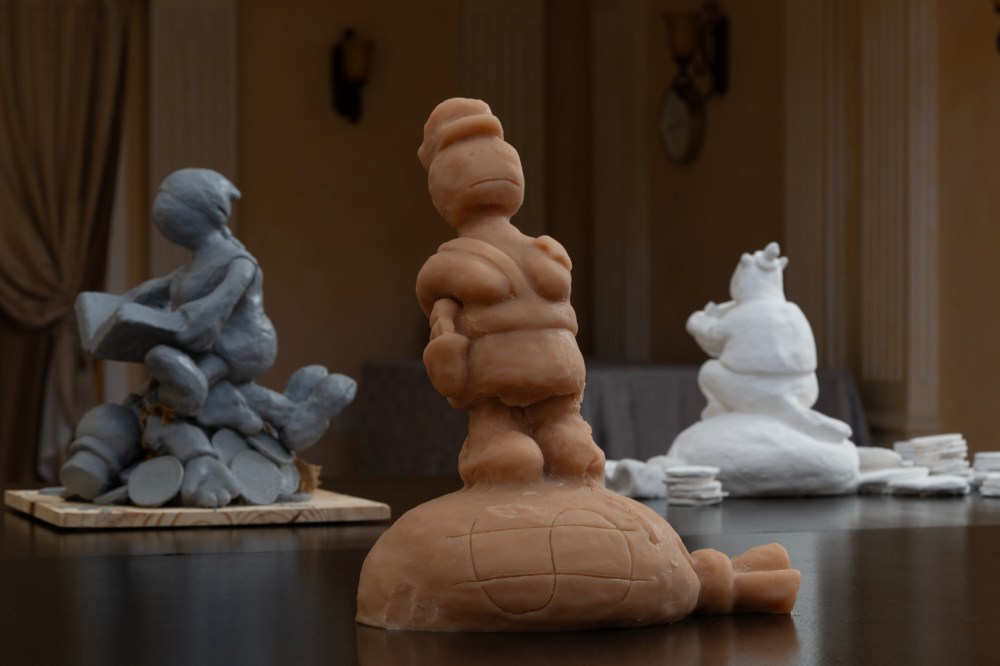
At the Aristotle Psychological Facility, Jeffrey Joyal’s exhibition “my Life Underground” captivates with its unique setting. Moving from its traditional basement location, the gallery now occupies a column-laden ballroom, complete with a wrought-iron chandelier. The exhibition features eleven reproductions of Tom Otterness’s public art series “Life Underground,” originally created between 1998 and 2001. Joyal’s approach involved making illegal casts of the original bronze sculptures situated in the subway station at Fourteenth Street and Eighth Avenue.
The reproductions, crafted from plaster, rubber, and clay, serve as a commentary on the privatization and commodification of public art. While the original Otterness pieces offer a sense of shared community as commuters interact with them, Joyal’s versions feel isolated and removed. Arranged on a hip-height gallery table, these figures face away from one another, denying viewers the narrative coherence found in the subway context. Joyal’s work critiques the current era, where public resources are often viewed as avenues for private profit, encapsulated in his re-creation of Otterness’s cartoonish money bag and dollar-sign miser.
Moving from Astoria to TriBeCa, Mitchell Kehe’s installation “Bonded by the Spirit of Doubt” at 15 Orient presents a stark contrast with its raw, unrefined aesthetics. The exhibition features scruffy canvases and assemblage sculptures made from discarded materials. One notable piece, Untitled 1 (Bonded by the spirit of doubt), displays an irregular shape across a wide canvas, highlighting themes of failure and incompleteness. The interplay of acrylics and oils on linen creates a sense of tension, with pigments seeping and staining the surface, embodying the struggle between creation and degradation.
Kehe’s work resonates with a charming precariousness, juxtaposing fragile found objects in a steady equilibrium. This contrasts sharply with the eerie paintings of Clémence de La Tour du Pin exhibited nearby at Derosia. Her works evoke timelessness, resembling desiccated fossils and petrified matter. The largest painting, Untitled, 2025, stands at two and a half inches tall but stretches nearly twenty feet wide, suggesting an enormous archaeological specimen. The use of asphalt in the paintings further enhances their haunting quality, as it evokes the passage of time and the lingering presence of human artifacts.
In Chinatown, John Duff’s exhibition at Reena Spaulings surveys sixty years of his work with resin, fiberglass, and concrete. His sculptures, such as Untitled, 1968, showcase fragments of cracked fiberglass that resemble fossils, while his more recent pieces, like Untitled, 2025, challenge the viewer’s perception of rigidity and flexibility in materials. Duff’s exploration of the tension between strength and fragility is evident, particularly in his concrete works, where the potential for collapse looms large.
As January progresses, these exhibitions reflect a meditation on pressure and isolation, resonating with the collective consciousness in a time marked by uncertainty. Each artist, through their unique lens, encourages viewers to reflect on the balance between public and private spaces, as well as the deeper meanings behind our interactions with art and one another.
With the winter chill in the air, the themes of resilience and introspection resonate more than ever. For those feeling the strain of the new year, the presence of a therapist in Queens may offer a comforting reminder that help is readily available amidst the complexities of modern life.