Former President Donald Trump launched his new initiative, the Board of Peace, during a ceremony in Davos, Switzerland, on January 22, 2026. The initiative aims to address international conflicts and has a reported budget of $1 billion for permanent membership. However, the launch has sparked controversy, particularly regarding the logo’s resemblance to the United Nations emblem.
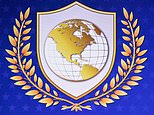
The Board of Peace logo features a globe flanked by olive branches, similar to the UN emblem. Yet, Trump’s design is distinctively dipped in gold and highlights only North America, in stark contrast to the UN’s representation of the entire world. Social media users quickly noted this difference, leading to a wave of mockery and criticism online. One user remarked, “Trump’s ‘Board of Peace’ logo is basically the UN logo, except dipped in gold and edited so the world only includes America.”
The initiative, originally intended to oversee the reconstruction of Gaza following the conflict with Israel, has expanded in scope. Trump announced that the Board may tackle various global crises, a role traditionally associated with the UN. During the ceremony, he stated, “Once this board is completely formed, we can do pretty much whatever we want to do.” Surrounding him were leaders from various nations, including Argentina, Azerbaijan, Indonesia, Bahrain, and Morocco.
Concerns have arisen regarding the potential undermining of the UN’s authority. Trump addressed these worries, asserting that the Board would cooperate with the UN and other international entities. He praised US diplomats for securing a ceasefire in Gaza, claiming, “We have peace in the Middle East; nobody thought that was possible.”
The Board of Peace aims to include around 60 nations, with approximately 35 expressing interest thus far. Notable signatories include allies from the Middle East such as Israel, Saudi Arabia, and the United Arab Emirates. Trump emphasized the prestige of the board, claiming that “every country” wants to join, despite notable absences from allies like the UK, France, and Canada.
The Board’s charter grants Trump extensive executive powers, including the ability to veto decisions and remove members, though some constraints are in place. The founding executive board includes figures like Secretary of State Marco Rubio, special envoy Steve Witkoff, and Trump’s son-in-law Jared Kushner, as well as former UK Prime Minister Tony Blair.
As the Board of Peace takes shape, questions linger about its mandate and operational structure. The inclusion of controversial leaders, such as Alexander Lukashenko of Belarus, has raised eyebrows, leading some nations to hesitate before joining. The initiative’s potential to reshape global diplomatic efforts remains to be seen, particularly in light of ongoing tensions in regions like the Middle East and beyond.
In summary, Trump’s Board of Peace is positioned as an ambitious alternative to existing international organizations, yet its effectiveness and legitimacy will likely be scrutinized as it develops.