
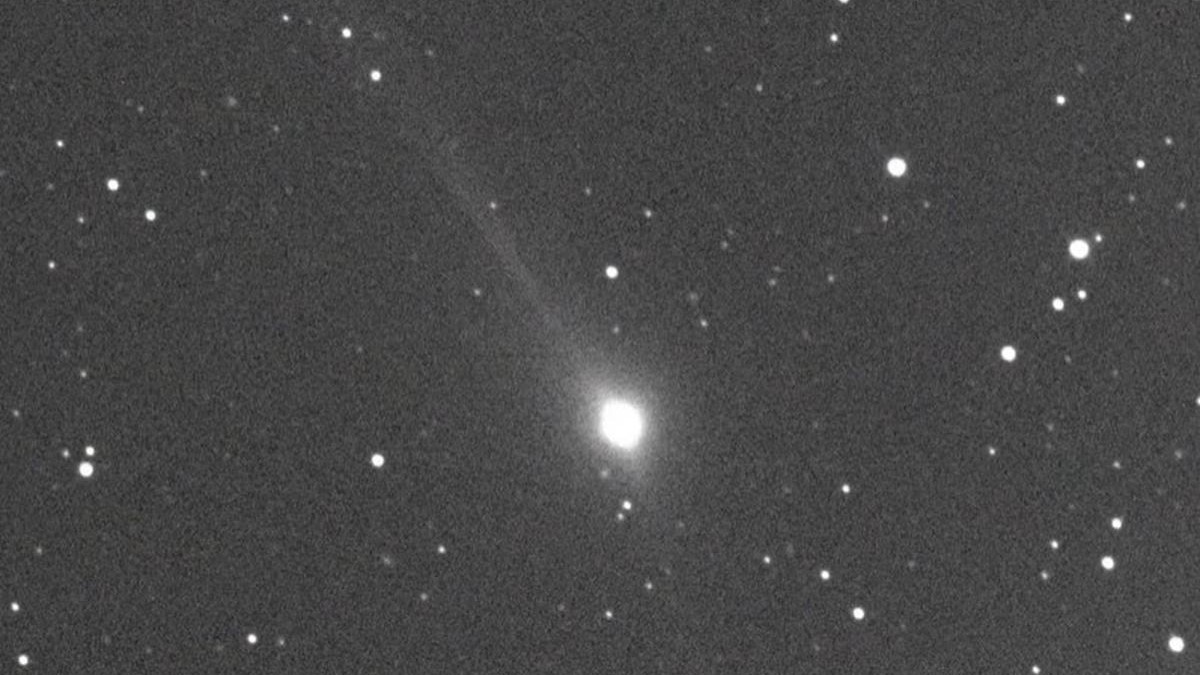
Stargazers have a final opportunity to witness the rare comet 3I/ATLAS as it embarks on its permanent exit from the solar system. This exceptional celestial object, which sparked discussions regarding its origins last year, is now on a confirmed trajectory away from Earth. Following poor weather conditions that delayed its presentation, the Virtual Telescope Project has rescheduled its live broadcast for Thursday, January 22, 2026, at 23:30 GMT (18:30 EST).
Final Viewing Opportunity
The event, titled “Farewell, 3I/ATLAS: A Final View of This Exceptional Object,” will provide real-time observations from robotic telescopes located in Manciano, Italy. On the rescheduled date, Earth will be positioned directly between the Sun and the comet, allowing sunlight to illuminate the comet in a manner similar to a full moon. This unique alignment offers the best chance to observe the faint comet against the vastness of space.
Comet 3I/ATLAS was first detected on July 1, 2025, by a remote telescope in Río Hurtado, Chile, as part of the Asteroid Terrestrial-impact Last Alert System (ATLAS). Initially identified as A11pl3Z, it was later renamed C/2025 N1 ATLAS when scientists confirmed its comet-like behavior. Subsequent analysis revealed that the object follows a hyperbolic orbit, indicating it is not bound to the Sun’s gravity and is instead a visitor from another star system.
A Striking Scientific Debate
The arrival of 3I/ATLAS has prompted significant speculation about its nature. Notably, Harvard astrophysicist Dr. Avi Loeb proposed that it might be an artificial construct rather than a natural celestial body. This theory ignited a wave of online discourse, despite the lack of substantial evidence supporting such claims.
Research conducted by NASA’s Psyche mission and the European Space Agency’s Mars Trace Gas Orbiter has provided insights into the comet’s characteristics. The object is exhibiting acceleration consistent with natural outgassing, a process where jets of vaporized gas escape its surface, functioning as tiny thrusters. This behavior aligns with that of comets found within our own solar system, effectively ruling out the possibility of artificial propulsion.
The comet is currently traversing the pre-dawn sky and will remain visible in this region until spring in the Northern Hemisphere. However, it is too faint to be seen without specialized equipment. Observers require at least a large 8-inch digital telescope to image the comet, while those aiming for optical viewing through an eyepiece need a substantial 16-inch telescope to resolve this distant object.
As 3I/ATLAS makes its final approach, this livestream event represents a critical moment for astronomy enthusiasts. Once it vanishes from view following this last appearance, it will return to the interstellar medium, likely traveling back toward the center of the Milky Way, leaving behind no trace for future observers. The fleeting nature of this interstellar visitor underscores both the wonder of space exploration and the importance of timely observation.


