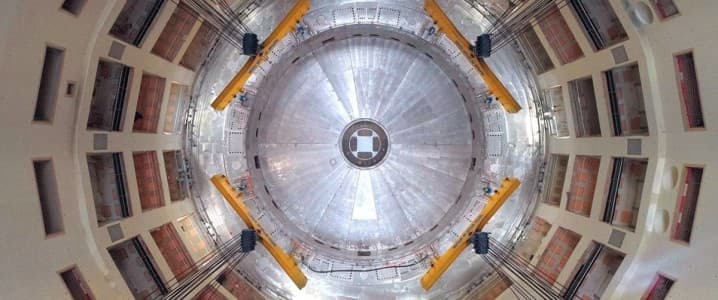
Chinese scientists have recently reported a significant advancement in nuclear fusion research, overcoming a critical barrier that has long hindered progress in this area. According to a study published in Science Advances, researchers successfully surpassed the Greenwald density limit, a threshold that has traditionally led to disruptions in tokamak operations, which are essential for achieving sustained nuclear fusion.
This breakthrough is vital for the future of nuclear fusion as it could help pave the way towards energy breakeven—a point where the energy output equals the energy input. The researchers emphasized the importance of high plasma density operation in achieving this goal, stating, “High plasma density operation is crucial for a tokamak to achieve energy breakeven and burning plasma.” The Greenwald density limit has posed a long-standing challenge in magnetic confinement fusion research, resulting in instability and spontaneous energy release beyond this threshold.
Utilizing a newly developed theoretical model, the research team was able to manipulate plasma behavior, allowing it to operate beyond the established density limit without becoming unstable. This experiment effectively demonstrated the existence of what they termed a “density-free zone,” a concept previously only hypothesized.
While this achievement does not guarantee the immediate availability of functional fusion reactors, it marks an important step forward in the quest for a viable fusion energy solution. Nuclear fusion, the process that powers the Sun, promises a future of zero-emission energy generation by fusing light atoms, such as hydrogen, into heavier elements like helium.
China has committed substantial resources to fusion research, investing approximately $13 billion over the past three years. The country aims to develop a working fusion reactor by 2030, showcasing its determination to lead in this field. Notably, China is pursuing multiple fusion approaches, including magnetic confinement, which is currently being utilized in its existing tokamak, and inertial confinement, which employs lasers. Speculation surrounds plans for a second tokamak, which may incorporate laser technology or electric currents to enhance fusion capabilities.
Recent years have seen a surge in advancements in nuclear fusion research, yet significant engineering challenges remain before the technology can transition from theoretical research to practical application. As China continues to make strides in this domain, concerns are growing in the United States regarding the potential implications of China’s advancements.
Republican Congressman Randy Weber, chair of the House Science, Space, and Technology Committee’s Energy Subcommittee, highlighted these concerns last year, stating, “Fusion energy technologies must be developed and deployed by nations that uphold democratic values, transparency, and international cooperation—not by authoritarian regimes that might exploit energy dominance as a weapon.”
As the competition in nuclear fusion research intensifies, the world watches closely to see how these developments will shape the future of energy generation and international relations.