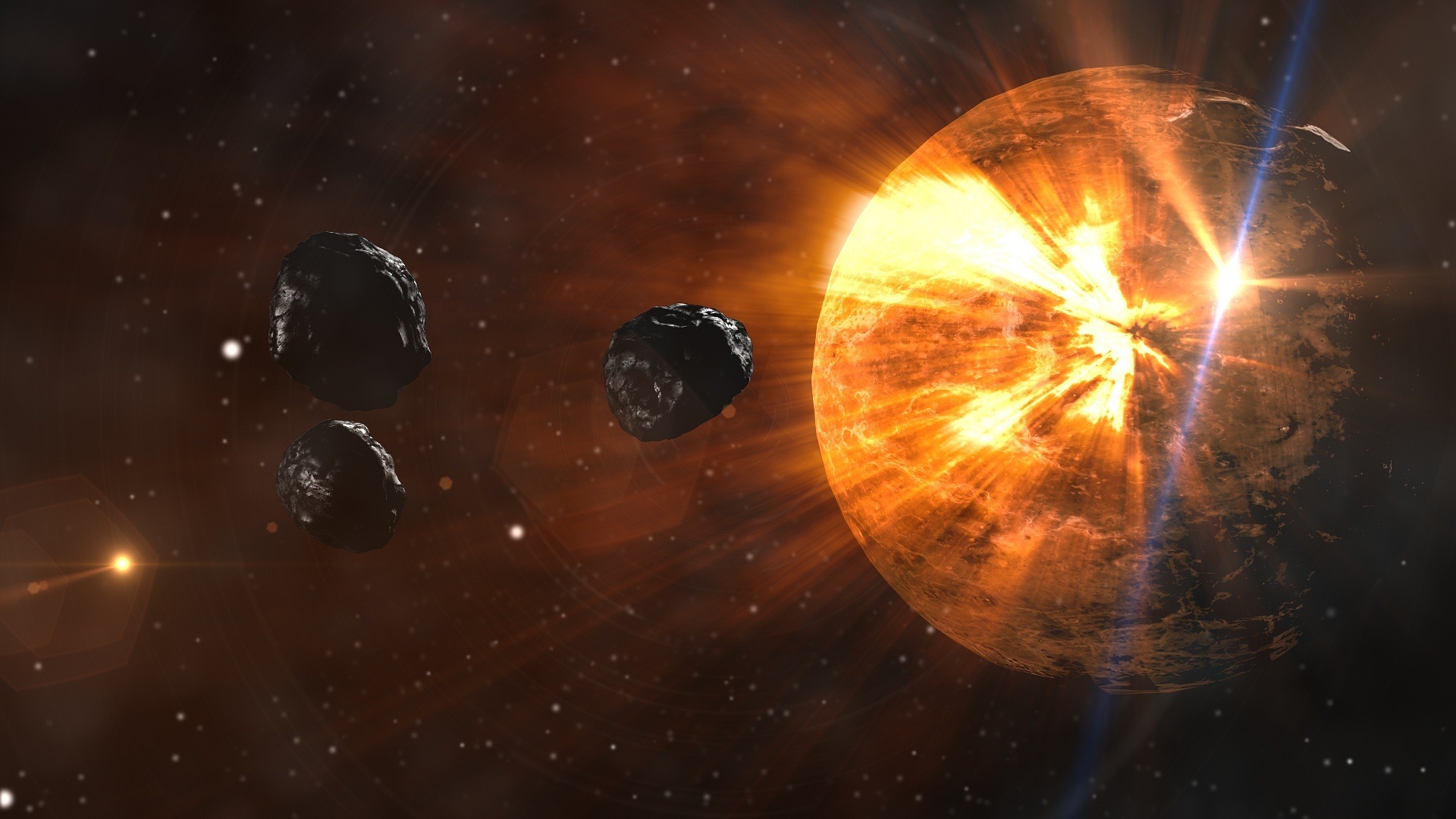
An early image of the interstellar object 3I/ATLAS has sparked significant debate among scientists, challenging traditional models of cometary behaviour. Captured by ground-based telescopes shortly after the object’s discovery, this unsettling image reveals a highly asymmetric light distribution that diverges from the expected characteristics of comets. While subsequent observations from NASA have confirmed its classification as a typical comet, the peculiar early image has led to speculation about the object’s true nature.
The initial image, taken weeks before more refined observations, displays an unusual “over-brightened, lopsided glow.” This has raised questions about whether it is merely an artefact or an important clue. Following the identification of its hyperbolic trajectory, astronomers recognized 3I/ATLAS as a rare and valuable object from beyond the solar system. Its interstellar origin has been established through archival observations by the Zwicky Transient Facility and follow-up imaging by various professional telescopes.
Scientific Observations and Controversies
Images from NASA assets such as the Hubble Space Telescope, the Solar and Heliospheric Observatory (SOHO), and the Mars Reconnaissance Orbiter have depicted a diffuse body with a coma typical of active comets. These observations confirm the presence of volatile outgassing as 3I/ATLAS approaches the Sun, with spectroscopic measurements identifying compounds such as carbon dioxide and water vapour. However, the early amateur image does not conform to the symmetric coma patterns expected from solar heating, leading many astronomers to dismiss it as noise or exposure artefacts.
The controversy intensified following remarks from Avi Loeb, an astrophysicist at Harvard University. Loeb suggested that certain features of 3I/ATLAS warrant a closer examination beyond conventional explanations. He applied his “Loeb scale,” which rates the likelihood of an artificial origin, placing 3I/ATLAS at a four. This indicates that while it aligns mostly with natural hypotheses, it cannot be entirely dismissed.
Loeb’s commentary raises several intriguing points: the object’s orientation within the solar system plane is statistically unusual, the early image’s asymmetry may suggest non-gravitational forces, and some spectral analyses indicate unexpectedly high nickel readings that challenge typical comet profiles. He has reiterated these views in various interviews, emphasizing perceived gaps in NASA‘s public data releases.
Settled Science vs. Public Speculation
Despite Loeb’s claims, mainstream scientific communities have consistently reaffirmed the natural cometary status of 3I/ATLAS. Peer-reviewed publications have reiterated that the observed features, including anti-tails and irregular jet structures, result from expected variations due to outgassing asymmetries and viewing angles. Researchers publishing on platforms like arXiv have provided robust spectroscopic evidence of water and carbon dioxide in the comet’s coma, reinforcing its classification as an active comet.
Public discourse surrounding 3I/ATLAS has been fraught with misinformation. Deepfake videos misrepresenting quotes from prominent physicists such as Michio Kaku regarding alien origins have been publicly disavowed. These scientists clarified their views on 3I/ATLAS‘s nature, denouncing misrepresentation. Online forums are inundated with misleading content, complicating efforts to distinguish real scientific findings from conjecture.
The release of images on November 19, 2025, by NASA and collaborating agencies provided clarity, showcasing the comet’s characteristic coma and confirming its hyperbolic trajectory. Among experts, there is a consensus that 3I/ATLAS does not pose any threat to Earth. Rather, it represents a remarkable natural visitor from beyond our solar system, continuing to captivate the scientific community and the public alike.