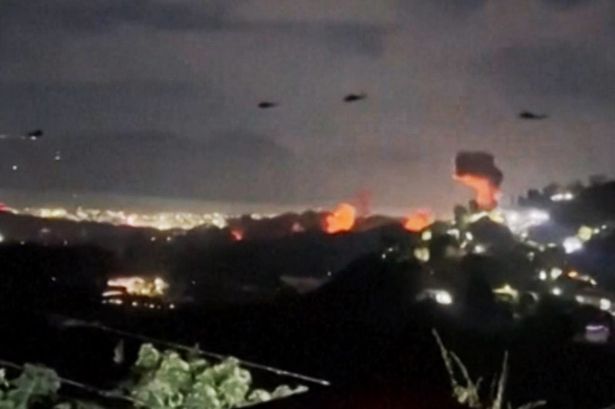
The United States Army conducted a significant operation leading to the capture of former Venezuelan President Nicolás Maduro and his wife, Cilia Flores, marking a pivotal moment in U.S.-Venezuelan relations. The raid, described by President Donald Trump as “large scale” and successful, resulted in both individuals being indicted on serious charges in a New York court.
The operation unfolded early on March 15, 2024, in Caracas, Venezuela’s capital. U.S. forces, operating under a directive from the Trump administration, executed the raid with precision, aimed at apprehending Maduro, who has faced long-standing accusations of corruption and drug trafficking. Following the capture, Trump declared the mission a necessary step toward restoring democracy in Venezuela.
In the aftermath, Maduro and Flores were flown to the United States, where they faced multiple charges, including conspiracy to traffic narcotics. According to a statement from the U.S. Department of Justice, the indictments are part of a broader strategy to combat drug trafficking networks that have plagued the region for years.
Trump emphasized the importance of this operation during a press conference, stating, “This is a clear message to dictators around the world. The United States will stand firm against those who undermine democracy and harm our citizens.” His administration has long sought to undermine Maduro’s regime, which has been criticized for its authoritarian practices and economic mismanagement.
The capture of Maduro is expected to have significant implications not only for Venezuela but also for U.S. foreign policy in Latin America. Analysts suggest that this operation could embolden opposition forces within Venezuela, potentially leading to a shift in power dynamics.
Venezuelan citizens have reacted with a mix of hope and skepticism. Many view the capture as a potential turning point in a country grappling with severe economic hardships and political unrest. Protesters gathered in Caracas, some celebrating the news while others expressed concerns about the future of their country amid ongoing instability.
The U.S. military operation has drawn varied responses from international leaders. While some countries applauded the action as a necessary step towards justice, others condemned it as an infringement on Venezuela’s sovereignty. The situation continues to evolve, with diplomatic discussions likely to follow as the world watches closely.
As the legal proceedings begin in New York, the focus will shift to the evidence presented against Maduro and Flores. These developments could further illuminate the complexities of the U.S.-Venezuela relationship and the broader implications for Latin American geopolitics.
In conclusion, the successful capture of Nicolás Maduro and Cilia Flores marks a significant chapter in U.S. efforts to confront challenges posed by authoritarian regimes in Latin America. The repercussions of this operation will be felt for years to come as the region navigates its path forward.