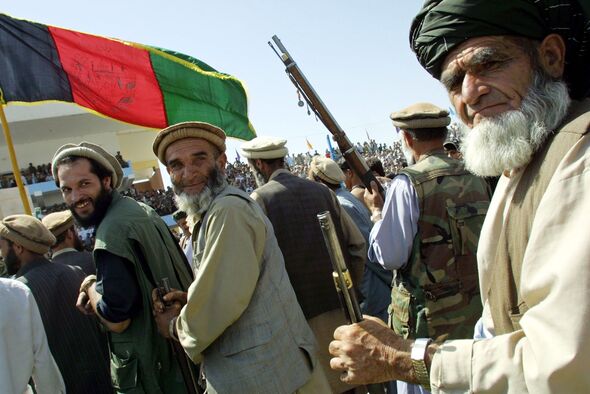
The Taliban has reinstated public executions and corporal punishment in Afghanistan, marking a dramatic return to brutal practices reminiscent of their previous rule. According to data from the Taliban’s Supreme Court, over 1,030 individuals faced public flogging in 2025, and instances of execution are reportedly on the rise. This resurgence of harsh penalties signals a significant shift in the regime’s treatment of its citizens, particularly as it grapples with internal and international pressures.
In a recent high-profile case, a man convicted of murder was executed in front of a crowd of approximately 80,000 spectators at a sports stadium in Khost province. The execution was notable not only for its scale but also for the involvement of a young boy, believed to be 13 years old, who acted as the executioner. The convicted individual, known as Mangal, was found guilty of killing 13 members of the victim’s family, including women and children.
The Supreme Court of Afghanistan issued a statement on the execution, emphasizing that the victim’s family had declined the option of forgiveness and insisted on the punishment of qisas, or retaliation. The court’s statement highlighted the adherence to their interpretation of Islamic law, stating, “At the conclusion of the gathering, prayers were made for the strengthening of national security and for the proper implementation of Islamic Sharia throughout the country.”
Rising Use of Corporal Punishment
The figures released indicate a dramatic increase in the use of corporal punishment since the Taliban regained power in 2021. The number of public floggings has nearly doubled compared to previous years, with Kabul recording the highest rates. Offences such as theft and other acts deemed contrary to Islamic law have drawn harsh penalties, including public beatings and executions.
The Taliban’s methods include not only traditional forms of punishment but also extreme measures such as executions by collapsing walls. Official records show that there have been at least 178 execution orders issued under the doctrine of qisas in the past four years. Among these, the regime has documented 37 death sentences by stoning and four executions carried out via wall collapses. This pattern reflects a systematic reliance on capital punishment, raising alarm among human rights advocates.
International organizations, including the United Nations, have condemned these practices as inhumane. The UN has described the Khost execution as “inhuman and cruel,” underscoring the global outcry against the Taliban’s harsh legal system.
Public Sentiment and International Response
The resurgence of public executions has sparked mixed reactions within Afghanistan. While some segments of society express support for the Taliban’s strict enforcement of Islamic law, others fear the ramifications of such brutal measures. The Taliban’s efforts to prevent recordings of executions by banning mobile phones in stadiums reflect their awareness of international scrutiny and the potential for backlash.
The implications of these actions extend beyond national borders, as countries and organizations continue to monitor the situation in Afghanistan. The Taliban’s approach to governance and justice will likely remain a focal point in discussions surrounding international aid and diplomatic relations.
As the Taliban consolidates its power, the return to such extreme measures raises critical questions about the future of human rights and governance in Afghanistan. The world watches closely as the regime continues to navigate its path amid evolving internal and external challenges.