
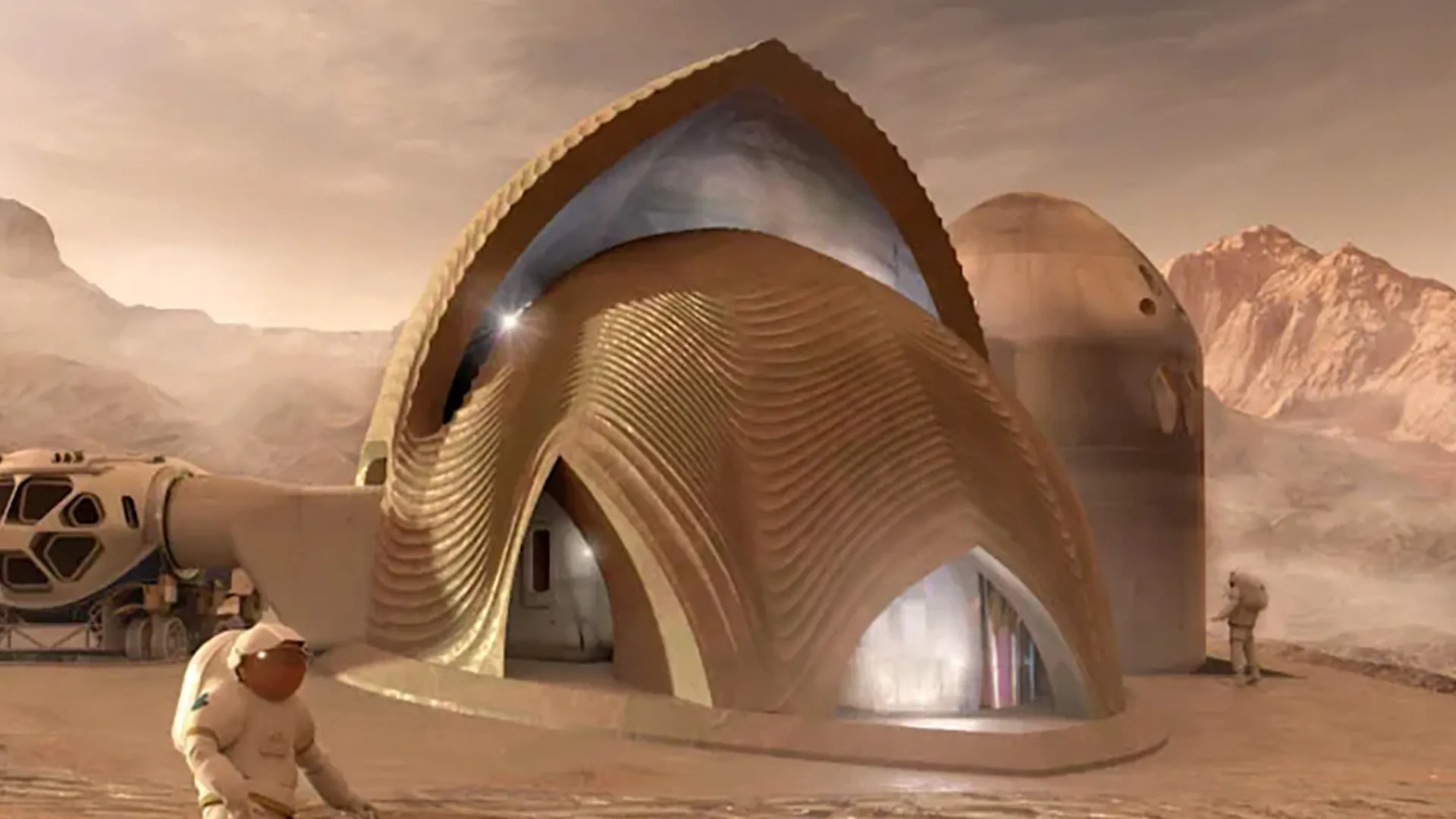
The potential for future space colonists to inhabit 3D-printed homes on the Moon and Mars is becoming a tangible reality, following the conclusion of NASA’s Centennial Challenge. This initiative, which spanned four years, invited designers to create innovative habitats suitable for deep space exploration, showcasing concepts that highlight how humans might live off-Earth.
NASA’s Steve Jurczyk emphasized the importance of shelter as humanity prepares for extended missions beyond Earth. He noted the need to utilize local resources, stating, “We recycle here on Earth – why not on Mars?” This approach aims to minimize the weight and space required for essential supplies during space travel.
Several intriguing designs emerged from the challenge, each utilizing advanced technologies and materials sourced from the lunar and Martian environments.
Innovative Concepts for Space Habitats
One notable design is the collaboration between Hassell and EOC, which envisions a fleet of wheeled mining robots. These robots would excavate regolith, a soil-like material, to create building feedstock. Once processed, the material would be used to 3D-print structures that blend seamlessly with the Martian landscape, taking advantage of local resources for both aesthetic and practical benefits.
The Kahn-Yates design features a unique habitat made from inner and outer polymer shells, encasing a layer of “sulphur concrete.” This design allows natural light to enter through openings, while the interior space can be divided into three levels, resembling a townhouse for Martian inhabitants.
Another innovative concept is the Mars Incubator, designed in a hub-and-spoke configuration. This model places a central living space surrounded by modules constructed from polyethylene and basalt fiber. Robots would assemble these panels directly on the Martian surface, incorporating essential environmental control systems for life support.
Team AI. SpaceFactory, based in New York, proposed a towering structure made from bioplastic reinforced with basalt fiber. This cylindrical design maximizes usable living space while accommodating temperature fluctuations on Mars due to its double-shell structure.
Addressing Challenges in Space Construction
The Northwestern University design introduces the idea of rovers creating foundations through 3D printing, followed by the deployment of an inflatable shell. This structure would be safeguarded by an outer shell, allowing for multiple modular habitats connected by tunnels, facilitating efficient living conditions for crews.
SEArch+/Apis Cor’s design focuses on radiation shielding, a critical consideration for the health of space colonists. Using high-density polyethylene and regolith, their homes feature overlapping shells that permit natural light while ensuring protection from harmful radiation.
Team Zopherus has developed a mobile 3D printer that collects local materials, such as calcium oxide and Martian rock, to create building materials. This printer would operate from a lander that moves across the planetary surface, allowing for continuous construction as new habitats are needed.
Lastly, the X-Arc concept employs materials extracted from the Martian surface to produce a multi-level habitat structure. The design incorporates polyethylene and ground basalt to create a 3D-printed shell, integrating pre-made components with robotic assistance.
While these designs are still conceptual, they represent significant advancements in the quest to establish human settlements on Mars and the Moon. As space agencies and private companies explore the feasibility of these habitats, the question of sustainable living in extraterrestrial environments inches closer to reality.


