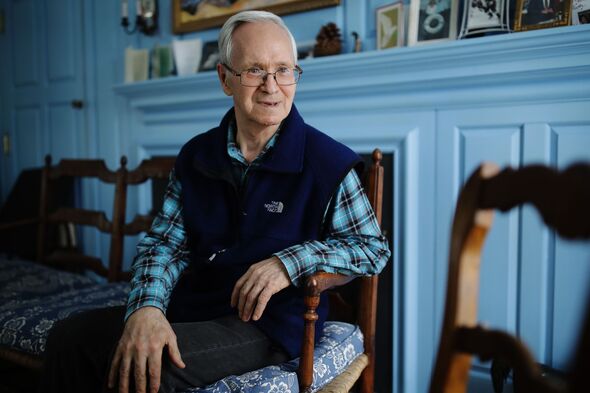
Dr. Vil Mirzayanov, a former scientist involved in the creation of the nerve agent known as Novichok, has expressed grave concerns that Russia under President Vladimir Putin is still engaged in the development of advanced chemical weapons. Mirzayanov, now 90 years old, played a pivotal role during the 1970s at the Gosniiokht institute in Moscow, where he helped formulate Novichok, a series of nerve agents designed to be more lethal than previous generations.
During the tumultuous final months of the Soviet Union, Mirzayanov took a courageous step by publicly revealing information about Novichok. In a 1990s interview with a Russian newspaper, he acknowledged the personal risks involved, believing that he might be imprisoned for his actions. Fortunately for him, following the collapse of the USSR, relevant laws were rendered obsolete, preventing any prosecution. Despite this, authorities attempted to bring him to trial in a “kangaroo court” in 1994. Ultimately, Mirzayanov relocated to the United States, but he remained troubled by the potential existence of Novichok stockpiles.
In 2008, he published a book detailing the chemical formulas for Novichok, only to be alarmed eight days later when former Russian military officer Sergei Skripal and his daughter, Yulia Skripal, were poisoned with the very nerve agent he had exposed. At the time, then-Prime Minister Theresa May confirmed that the attack was attributed to Novichok, generating widespread condemnation.
Mirzayanov was taken aback by the use of Novichok for an assassination attempt, stating that he never anticipated the weapon would be deployed in such a manner. Although the Russian government denied involvement in the attack that led to the death of Dawn Sturgess, a public inquiry indicated that Putin likely authorized the operation. The inquiry also criticized the failure to provide Skripal with a new identity upon his relocation to the United Kingdom. Experts noted that Skripal seemed to prefer living openly rather than in hiding.
Reflecting on the events surrounding the Skripal case, Mirzayanov theorized that the agents responsible for the attack were “in a rush,” resulting in an inadequate application of the poison. He also speculated that opposition leader Alexei Navalny, who was poisoned in 2020, was likely targeted with a different agent to avoid drawing attention to Novichok’s use in political assassinations. “I guess they used a new poison agent to kill Navalny,” he remarked. “Not Novichok, because they don’t want scandals connected to this violation of chemical weapons conventions.”
Mirzayanov’s insights into the ongoing chemical weapons development in Russia raise significant concerns. He fears that Putin is advancing new types of chemical agents that will be even more difficult to detect and counteract. His previous work at Foliant, a secretive program, was largely focused on finding ways to evade global bans on chemical weapons. He stated, “Those chemical weapons are only weapons of mass destruction against civilians, innocent people.”
As discussions regarding peace agreements in Ukraine continue, Mirzayanov cautioned that the international community should not be “naive.” He expressed skepticism about any agreements with Russia, asserting that such deals often come with loopholes designed to undermine their effectiveness. “In every deal Russia signs, they’re creating at least one loophole to circumvent this agreement,” he warned.
The insights of Dr. Mirzayanov highlight the complex and often dangerous landscape of chemical weapons development in Russia, underscoring the need for vigilance and accountability in international relations.