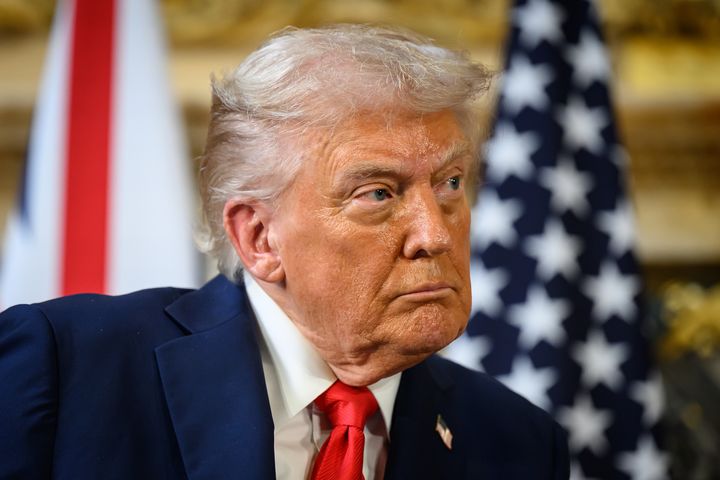
UPDATE: In a significant development, former President Donald Trump announced that a peace deal between Russia and Ukraine is “closer than ever before” following critical discussions with Ukrainian President Volodymyr Zelensky at his Mar-a-Lago resort in Florida. This urgent meeting signals a potential breakthrough in ongoing efforts to resolve the conflict, although both leaders acknowledged lingering “thorny issues.”
During a joint press conference, Trump stated that negotiations surrounding a crucial security guarantee are “close to 95%” finalized, emphasizing the increasing willingness of both parties to reach an agreement. “I really believe we’re probably… closer than, by far, closer than ever before – with both parties,” Trump remarked, highlighting the complex dynamics of the talks.
The leaders convened not only for bilateral discussions but also included a conference call with NATO Chief Mark Rutte and European leaders, including UK Labour leader Sir Keir Starmer. They collectively agreed that Trump will host European leaders and a Ukrainian delegation for further discussions in January 2024, possibly in Washington, D.C.
These talks mark the latest phase in Trump’s ongoing initiative to secure a ceasefire in Ukraine, a commitment he previously vowed to fulfill within his first day back in office. Zelensky disclosed that the draft peace plan includes a US commitment to security guarantees akin to NATO’s Article 5, meaning an attack on Ukraine would trigger a collective military response from the US and its allies.
Zelensky noted that while the 20-point draft plan is “90% agreed,” the US-Ukraine security guarantees are “100% agreed,” with US-Europe-Ukraine security guarantees “almost agreed.” Trump acknowledged the challenges ahead, saying, “It’s very complicated stuff” but expressed optimism about the chances of reaching a conclusive agreement.
One unresolved aspect remains the potential creation of a free trade zone in the Donbas region, a critical issue that has yet to be fully addressed. Zelensky has indicated a willingness to withdraw troops from Ukraine’s eastern industrial heartland, contingent on Russia’s reciprocal actions and the establishment of a demilitarized zone monitored by international forces.
When asked about the future of the Donbas, Zelensky reiterated that any agreement would require either parliamentary approval or a referendum among the Ukrainian people. “If the plan will be very difficult for our society… our society has to choose and has to vote, because it’s their land,” he stated, highlighting the complex emotions tied to the territorial disputes.
Trump also revealed he spoke with Russian President Vladimir Putin earlier on Sunday, discussing Ukraine’s post-war reconstruction. He reported that “Russia’s going to be helping,” despite ongoing attacks preceding the Florida meeting. Trump’s assertion that Putin is “very serious” about peace raises questions about Russia’s willingness to cooperate.
As discussions continue, Zelensky maintains resistance to Russian demands for Ukraine to relinquish control of the eastern regions of Luhansk and Donetsk. Additionally, Russia’s opposition to NATO forces monitoring a ceasefire complicates the negotiations. European leaders, including Starmer and French President Emmanuel Macron, have stressed that robust security guarantees are essential for any potential agreement.
Downing Street emphasized the UK’s commitment to advancing peace talks, with Starmer expressing eagerness to sustain momentum. “We must end this barbaric war as soon as possible,” he urged, underscoring the urgency felt by leaders across Europe for a resolution.
As the situation develops, global attention remains fixed on the potential for peace in Ukraine, with lives and futures at stake. The next round of discussions in January will be pivotal in determining the course of events.