Newly released documents from the National Archives of Ireland reveal that Irish officials anticipated the September 11 attacks would significantly alter how US politicians approached the Northern Ireland peace process. In a briefing prepared on September 12, 2001, an unnamed government official discussed the potential repercussions of the attacks that killed over 2,900 people and injured thousands more.
The briefing highlighted that it was “very early days” to fully understand the impact on the foreign policy of the George W. Bush administration. Nonetheless, the official predicted a shift in focus towards internal security and terrorism, which would dominate the political agenda for the foreseeable future. US legislators had previously shown considerable interest in the peace process, particularly in relation to the Good Friday Agreement of 1998 and subsequent peace initiatives.
Officials recognized that the Northern Ireland peace process would now have to compete for attention within US foreign policy. They expressed concern that the war on terrorism might prompt US legislators to adopt a stricter stance towards republican groups in Northern Ireland, influenced by what the official described as the “whiff of cordite.”
The document suggested that these dynamics should be taken into account when planning engagements related to the review of the Good Friday Agreement, as well as the timing of visits to Washington, D.C.. The official noted that President Bush’s assertion of making “no distinction between the terrorists who committed these acts and those who harbour them” could signal a shift towards a zero-tolerance policy on terrorism, shaping US foreign and defense strategies.
As the document elaborated, US foreign policy was expected to be driven by the necessity of combating international terrorism. It indicated that this focus would lead to security-oriented policy advice from agencies like the FBI and the US Department of Justice being prioritized over more nuanced approaches from the State Department or National Security Council.
“Defeating terrorism will become a central organizing principle for US policy for some time to come,” the official stated. They expressed concern that US policymakers might not differentiate between various terrorist organizations, their transitions from paramilitary activities to political engagement, or between their military and political factions.
Despite the September 11 attackers’ affiliations with groups from the Middle East, the document warned that the republican movement could face increased scrutiny in the US, as all forms of “terrorism” might be lumped together in the public consciousness. The briefing predicted that republicans could encounter a “very chilly” and “more hostile environment” in the US if they did not act swiftly on disarmament and clarify their ties to the Colombian guerilla group FARC.
The official underscored the potential consequences of failing to fulfill commitments regarding illegal arms, stating, “The republican movement’s attempts to prevent itself from being so branded will be seriously undermined by its perceived failure to meet its commitments.” Historically, the Irish-American caucus in Congress had largely supported the republican movement’s engagement in democratic politics, despite its militant past.
However, with a shift in congressional sentiment aligning with the administration’s perspective on the war on terrorism, Irish-American legislators might feel compelled to adopt a more stringent approach towards the republican movement. The document noted that while Sinn Féin’s leadership had enjoyed a degree of celebrity among Irish-Americans, this status could suffer in the new political climate following the attacks.
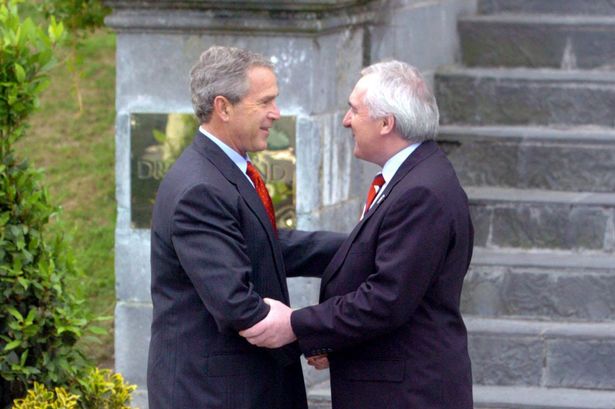
On the day of the attacks, former taoiseach Bertie Ahern reached out to President Bush to offer Ireland’s condolences. Ahern expressed his shock and deep sadness over the “terrible and evil events” and condemned the attacks as “horrendous and unprecedented.”
In the weeks that followed, Irish officials closely monitored US political discourse surrounding the attacks. Notably, former White House press secretary Ari Fleischer referenced the IRA when discussing potential targets in the war on terrorism, although he later clarified that US actions would focus on groups posing a direct threat to the United States.
These insights from the briefing document indicate a pivotal moment in US-Irish relations and highlight the complexities of foreign policy in the aftermath of a global tragedy. As the world shifted in response to the September 11 attacks, so too did the dynamics surrounding the peace process in Northern Ireland.