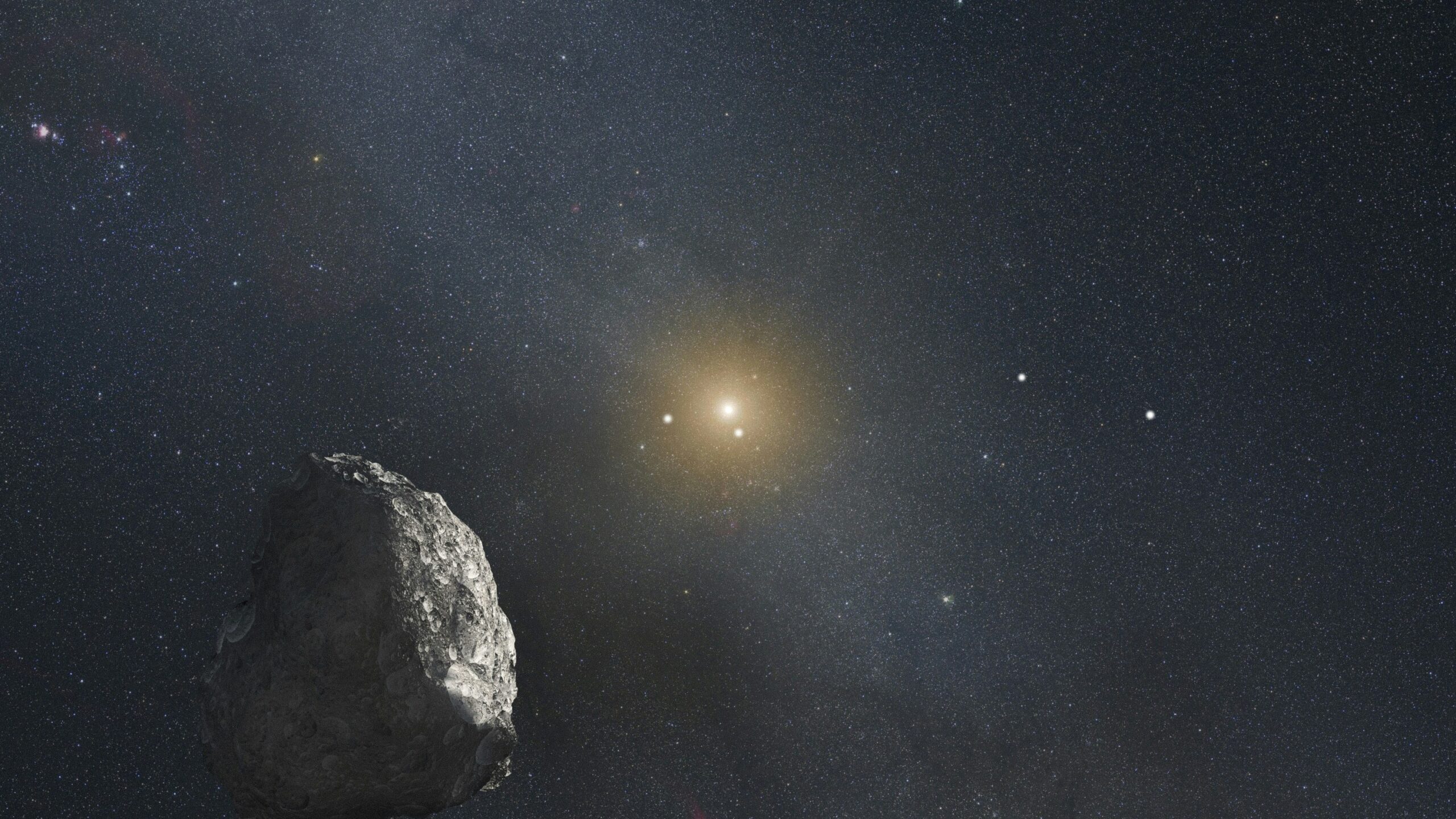
The interstellar comet 3I/ATLAS has sparked a renewed debate surrounding the existence of extraterrestrial life. On December 19, 2025, the comet made its closest approach to Earth, skimming past at a distance of approximately 270 million kilometres (168 million miles) at a staggering speed of 153,000 mph. While many in the scientific community view 3I/ATLAS as a natural celestial object, Harvard physicist Avi Loeb has raised concerns about its unusual chemical signatures, suggesting the possibility of an artificial origin.
As 3I/ATLAS continues its journey through our solar system, the divergence in opinions is clear. Loeb, known for his provocative theories regarding unidentified objects in space, argues that the comet’s composition warrants further scrutiny. He specifically highlights measurements of the object’s coma—the gaseous envelope surrounding the nucleus—indicating the presence of nickel and iron atoms, elements typically not expected to vaporize easily under the cold conditions of space.
In a blog post from October, Loeb emphasized that at the distances where comets are typically observed, temperatures are generally too low to vaporize heavy elements. He stated, “At the distances at which comets are observed, the temperature is far too low to vaporize silicate, sulphide, and metallic grains that contain nickel and iron atoms.” This assertion forms the basis of his hypothesis that 3I/ATLAS may not be a standard comet but could represent something more significant.
In stark contrast, NASA has firmly rebutted Loeb’s claims. The agency’s scientists assert that there is “overwhelming evidence” supporting the idea that 3I/ATLAS is a natural comet. Tom Statler, a lead scientist at NASA, noted, “It looks like a comet. It does comet things. It very, very strongly resembles, in just about every way, the comets that we know.” He acknowledged that while 3I/ATLAS may possess some atypical features, those differences do not necessitate an artificial explanation.
Loeb has also made a dramatic analogy regarding the risks of potential alien technology, likening the encounter with such interstellar objects to a “blind date of interstellar proportions,” where one cannot predict if the visitor is friendly or harmful. This comment underscores the excitement and danger associated with pondering the nature of such objects from beyond our solar system.
As the debate continues, 3I/ATLAS is moving away from Earth, with trajectory models indicating it will pass by Jupiter in early 2026. Following this, it is expected to clear the orbits of Saturn, Uranus, and Neptune by 2028. Ultimately, it will follow a hyperbolic escape trajectory, gradually becoming less detectable as it recedes into the interstellar medium.
Although the fascination with the possibility of alien life persists, the current scientific consensus remains steadfast. Whether 3I/ATLAS turns out to be an extraordinary natural comet or a typical one from another star system, it serves as a reminder of the vastness of the universe and the mysteries that continue to unfold. As we observe such celestial phenomena, the quest for understanding remains as compelling as ever.