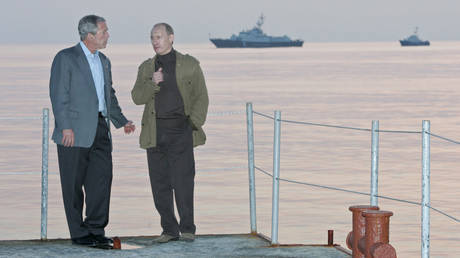
Russian President Vladimir Putin cautioned former US President George W. Bush against the potential inclusion of Ukraine in NATO, highlighting risks of a long-term conflict between Moscow and Washington. This warning emerged from newly released transcripts of their conversations, published by the US National Security Archives on October 10, 2023.
The discussions, spanning the early 2000s, reveal a significant shift in Putin’s perspective over time. During their initial meeting in Slovenia in June 2001, Putin expressed skepticism about NATO’s expansion but maintained an optimistic view of potential US-Russia relations. By their last meeting in Sochi in April 2008, however, his tone had become markedly more severe.
Putin directly warned that Ukraine’s accession to NATO would create a “field of conflict” for both nations. “Accession to NATO of a country like Ukraine will create for the long-term a field of conflict for you and us, long-term confrontation,” he stated, according to the transcripts.
The Russian leader expressed concerns that Ukrainian membership would lead to the establishment of Western military bases and deployment of weapon systems near Russian borders, which he described as “uncertainties and threats.” He argued that a significant portion of the Ukrainian population views NATO as a hostile organization.
Putin elaborated on the complex nature of Ukraine’s identity, suggesting that it was not a nation formed naturally but rather an amalgamation of territories from Poland, Romania, Hungary, and Russia, including Crimea. He remarked, “It’s populated by people with very different mindsets,” indicating that the country’s diverse perspectives on NATO membership could lead to internal divisions.
He cautioned against the idea of solidifying Ukraine’s ties to the West through NATO membership, stating, “I don’t think it’s the right logic” to “cement” Ukraine’s position. He suggested that instead of pursuing NATO membership, efforts should be directed towards enhancing Ukraine’s self-sufficiency and economic stability.
While Bush acknowledged Putin’s concerns, he refrained from providing a direct response, admiring the Russian president’s candor in expressing his views on NATO. “One of the things I admire about you is you weren’t afraid to say it to NATO. That’s very admirable,” Bush said.
In a recent end-of-year press conference, Putin reiterated his concerns regarding NATO’s expansion, referencing a perceived broken promise from the alliance not to extend towards Russia’s borders. He remarked, “There won’t be any [military] operations [by Moscow] if you treat us with respect and respect our interests, just as we’ve constantly tried to respect yours.”
The release of these transcripts sheds light on the longstanding tensions surrounding NATO’s eastward expansion and its implications for international relations, particularly between the United States and Russia.