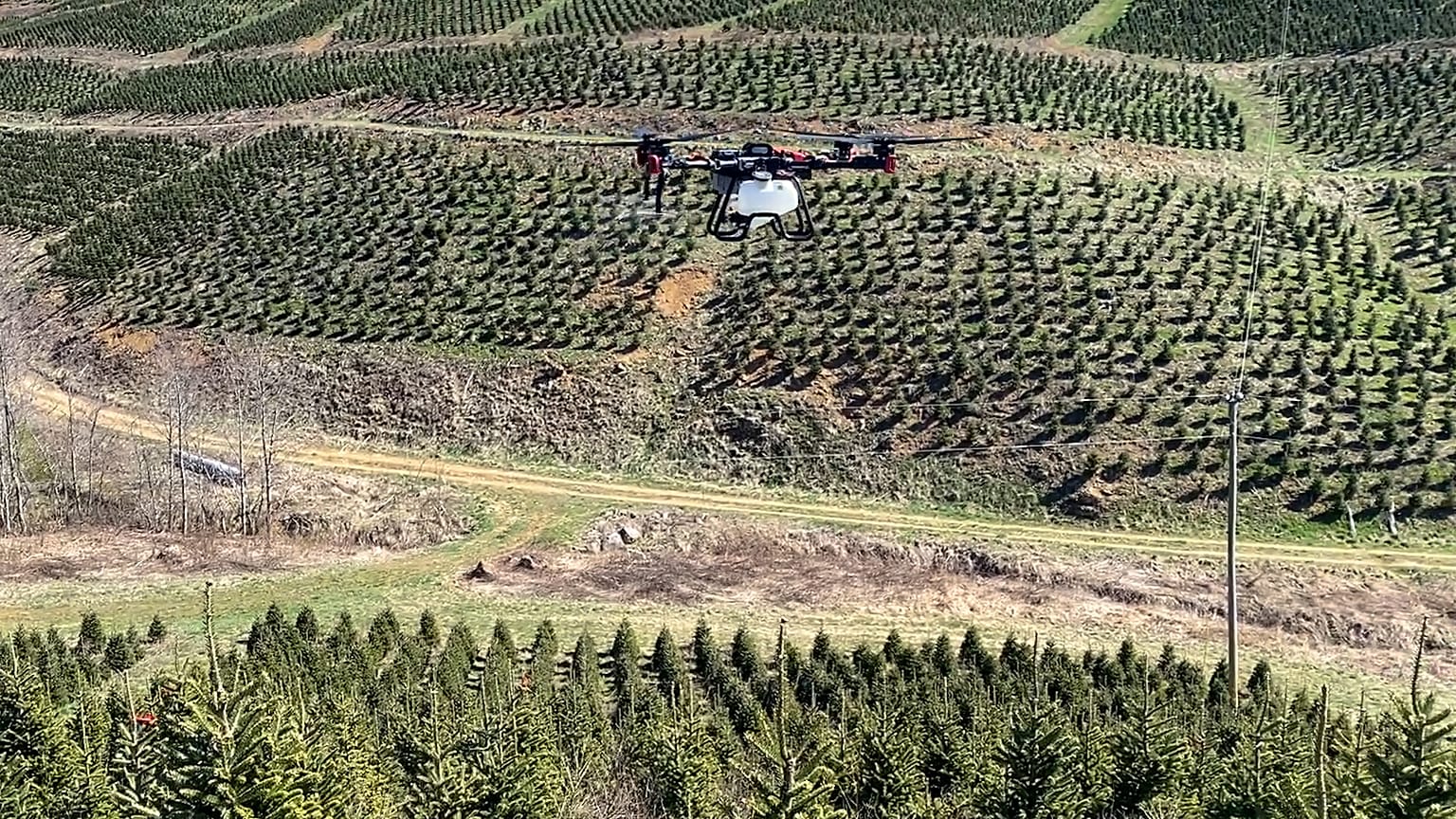
Christmas tree farms globally are increasingly incorporating technology such as drones, artificial intelligence (AI), and satellite imaging to enhance field management. As the festive season approaches, sellers across Europe are preparing to offer a range of firs for homes, offices, and public spaces. Behind the scenes, the cultivation of these trees is undergoing significant transformation.
In Denmark, the second largest producer of Christmas trees in Europe, farmers are utilizing drones and AI to streamline operations. According to the Danish Christmas Tree Association, Denmark stands as the world’s leading exporter of Christmas trees. A family-owned farm in the country has adopted the technology to replace traditional manual counting methods with drone and satellite-based imaging. This shift has significantly reduced the time spent walking through fields and minimized human error.
The Serbian AI firm Agremo shared insights into this transition. They reported that their system can map a 100-hectare plantation in approximately 30 minutes and count trees with an impressive accuracy of up to 98 percent. Luka Živković, Agremo’s head of sales, noted, “Some big nurseries that we work with have more than 100,000 trees, so measuring them would take a lot of labour and time.” Each tree is assigned an ID, facilitating tracking of growth and sales.
Regular monitoring of tree health is vital, given that Christmas trees generally require around a decade to reach maturity. Previously, farmers relied heavily on workers to count and measure trees, a process often fraught with inconsistencies. The integration of drones can help growers “save time and money,” allowing operations to continue during early hours and reducing reliance on manual labour.
In the United States, the Christmas Tree Extension programme at North Carolina State University supports local growers with practical, research-based guidance. North Carolina, which boasts around 33,000 acres (approximately 13,350 hectares) of Christmas tree cultivation, has seen a significant adoption of drone technology. William H. Kohlway IV, a production specialist at the university, remarked that drones have rapidly evolved from experimental tools to essential equipment, especially for larger growers.
Some producers are now investing in multiple drones due to their effectiveness in the field. The advancement of Light Detection And Ranging (LiDAR) technology allows detailed scanning of entire plantations. Drones are also capable of targeted spraying, applying fertilizers and herbicides precisely where needed. Kohlway stated, “A lot of the guys who used to mainly do the stuff have now become drone operators,” highlighting a shift in job roles within the industry.
In North Carolina, many Christmas tree farms are located on slopes where traditional machinery struggles. To address this, autonomous ground-based drones, akin to robotic mowers, are being developed for challenging terrains. Kohlway explained, “We have some Christmas tree fields at like 60, 70-degree slopes. The new heavy-duty mowers can handle those inclines.”
Despite the promise of drone technology, certain barriers hinder wider adoption. The costs associated with drones can be substantial, averaging around €25,600. Additionally, the necessary software, training, and strict aviation regulations can pose challenges, particularly for smaller growers. The Danish Christmas Tree Association pointed out that at present, drones are primarily utilized by larger companies for inventory assessments.
“Danish growers vary significantly in size, from small family companies to large enterprises. Their challenges and strategies for addressing them differ,” the association stated. Nevertheless, interest in drone technology is growing. Kohlway noted, “The adoption rate is rapidly increasing as drones improve, prices decrease, and growers become more technologically savvy. This trend is also attracting the next generation of growers.”
As Christmas tree farms continue to embrace these technological advances, the industry is poised for a future that combines tradition with innovation, ensuring efficient and sustainable practices in tree cultivation.