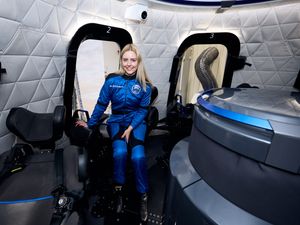
UPDATE: A groundbreaking moment in space travel has just taken place as Michaela Benthaus, a disabled engineer from Germany, has become the first wheelchair user to launch into space. She lifted off from West Texas aboard a Blue Origin rocket, fulfilling a lifelong dream alongside five other passengers on July 15, 2023.
This historic flight marks a significant leap towards inclusivity in space exploration, as Benthaus, severely injured in a mountain bike accident seven years ago, left her wheelchair behind to experience the wonders of weightlessness. The ten-minute journey, which included over three minutes of microgravity, was made possible through modifications to the autonomous New Shepard capsule designed by Blue Origin.
The mission, sponsored by Blue Origin and organized by retired SpaceX executive Hans Koenigsmann, was tailored to ensure accessibility. Benthaus utilized a patient transfer board for smooth movement between the capsule’s hatch and her seat, with an elevator already in place at the launch site to assist her ascent to the launch pad. Blue Origin engineer Jake Mills emphasized the capsule’s accessibility features, stating that it is “more accessible to a wider range of people than traditional spaceflight.”
Benthaus, who is currently part of the European Space Agency’s graduate trainee program, trained rigorously for this mission. She previously experienced brief moments of weightlessness during a parabolic flight in Houston in 2022 and participated in a simulated space mission in Poland. “I never really thought that going on a spaceflight would be a real option for me,” she explained before the flight, highlighting the competitive nature of space travel.
This mission is particularly momentous as it represents the first time a person with a severe disability has traveled to space. Benthaus’s journey could inspire future advancements in accessibility for both space travel and terrestrial environments. “I really hope it’s opening up for people like me; like I hope I’m only the start,” she stated, underscoring her determination to advocate for greater inclusion.
Joining Benthaus on this flight were various business executives and a computer scientist, bringing Blue Origin’s total number of space travelers to 86. The ticket prices for this mission were not disclosed, but the significance of the event extends far beyond financial aspects; it symbolizes hope and progress for individuals with disabilities.
As Blue Origin continues to pave the way for commercial space travel, this flight also sheds light on ongoing efforts to make space exploration more inclusive. The company has previously welcomed passengers with disabilities, including individuals with limited mobility and vision impairments.
Looking ahead, Benthaus’s journey is not just a personal victory; it raises critical questions about accessibility in all areas of life. Her experience could lead to broader discussions and innovations in how we approach inclusivity in various fields.
This mission, while private and independent of the European Space Agency, comes as ESA has cleared reserve astronaut John McFall, an amputee, for future flights to the International Space Station. The progress in this area is promising, yet Benthaus’s venture represents a landmark moment in the pursuit of equality in space exploration.
As we celebrate this historic launch, the world eagerly anticipates what the future holds for accessibility in space and how it will inspire the next generation of explorers.